

I’ve tested hundreds of grip socks over the years, and I’ve reached the same conclusion every time: the right pair won’t suddenly make you a better player, but they can make a well-fitted boot feel even better. That’s why I still wear them every match.
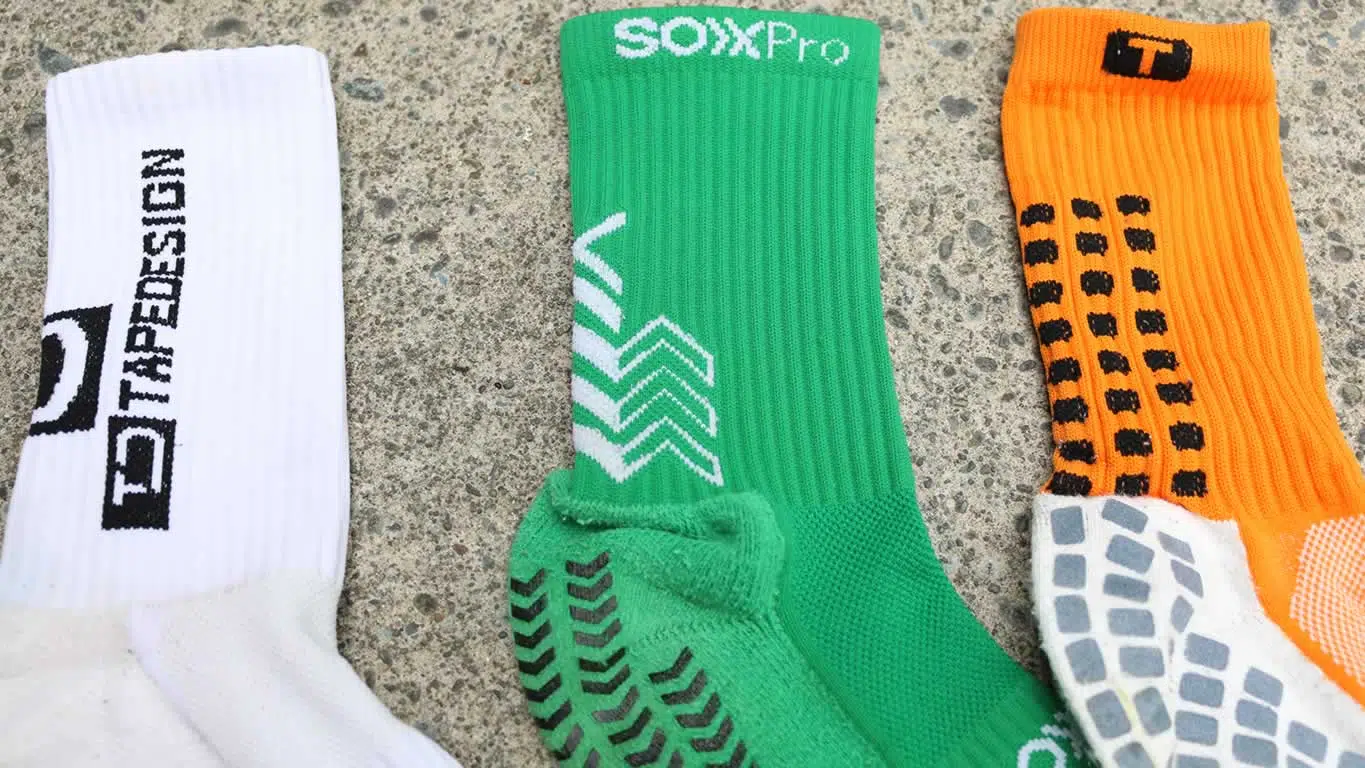
Which grip sock is right for you?
Both are thin enough to preserve the fit you bought. No volume addition, no forefoot pressure once your feet have swelled into the second half.
Thicker socks earn their place here. If your boot runs generous, a mid-thick or thick sock closes that gap and gives you lockdown you would not otherwise have.
Heel grip included at a price that makes sense for testing the concept. If grip socks turn out not to work for you, it is not an expensive lesson.
Pro-informed grip placement, mid-thickness, works across most boot types. My current pair. Use code BOOTS at advantedgesport.com/BOOTS.
Not sure which applies to you? The boot fit guide below covers snug vs generous fit in detail, including which sock thickness to use.
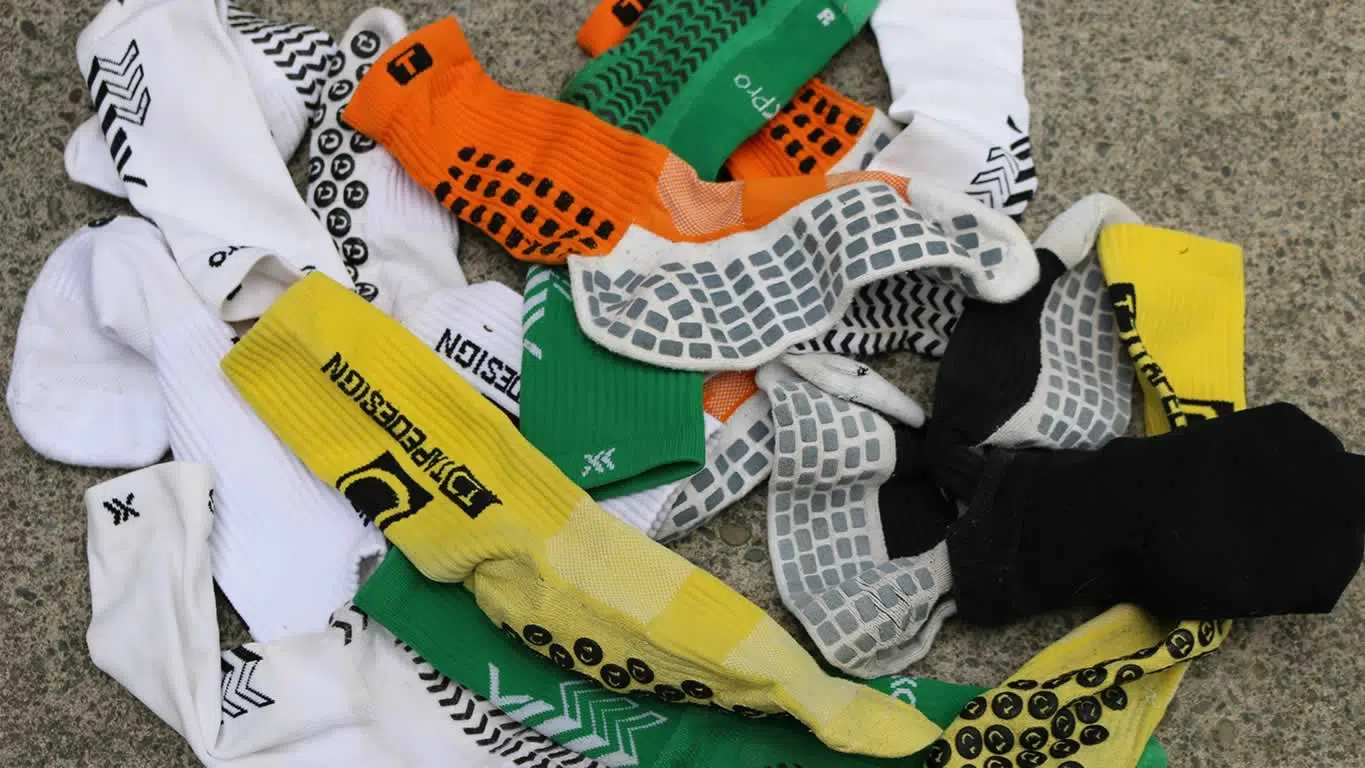
Top 12 Grip Socks

Forefoot and toe grip feels locked from the first minute. Works for most player types in snug to mid-volume boots.

96 grip points per sock including three on the big toe. High density without bulk — good for players in tighter boots.

Minimal bulk with strong compression. Best for snug speed boots where a thicker sock would compromise fit.

Grip extends to the heel — uncommon at this price. Good first pair if you want proper grip without the premium cost.
Read our review
High underfoot grip coverage with a ventilated top. Good for players who want grip across the full footbed, not just key zones.
Read our review
The originals from 2011. Suede-like pads inside and out. Bulkier fit — works for wider or higher-volume boots, not narrow openings.
Read our review
Worn by Rakitic and Griezmann. Soft cotton with circular rubber grip elements. Free-size approach can cause bunching on narrower feet.
Read our review
Dense rubber dots compensate for boots that run slightly large. Good ankle fit. Not ideal if your boots are already a snug fit.
Read our review
Best moisture management in the category. Strong ankle compression. Silicone dots can feel noticeable at first, especially on warmer feet.
Read our review
Made by boot reviewer Josh of SR4U. Anatomic sizing, triangular grip elements from forefoot to heel. Good value for a first pair.
Read our review
About a third the price of premium pairs. Square grip elements are more spaced and glossy than the market leaders. Functional backup option.
Read our review
Australian brand with good ankle and shin fit. Circular grip elements are competitive. Sizing note: 6-9 = Medium, 10+ = Large.
Read our reviewThe grip socks featured here, are designed and produced by their respective manufacturers. FootballBoots.co.uk is an independent, unaffiliated review site, and all opinions are our own. This page contains affiliate links, which may earn us a commission if you choose to purchase, but this does not influence our recommendations.

Why professional players wear grip socks — and what it actually changes on the pitch.

Playing indoor or on a hard court? See our best futsal shoes guide — different surface, different priorities.
What do grip socks actually do?
If you have ever planted your foot to cut inside and felt your toes slide slightly inside your boot, that is exactly the movement grip socks are designed to reduce. The grip elements sit between your foot and the boot interior, holding your foot in position during the moments that matter: sharp turns, sudden acceleration, striking through the ball, landing after a header.
Football boots are designed to fit as closely as possible, but even a well-fitted boot has some internal movement under the forces of play. A conventional sock provides almost no resistance to that movement. A grip sock does.
The first time I wore them properly, not just pulling them on for training but matching sock to boot, what struck me was how much more connected I felt to the ball. Not dramatic. Subtle. But real, and once you feel it you notice the absence when you go back to a regular sock.
- Foot lockdown inside the boot. Your heel stays planted on the insole during direction changes instead of lifting slightly with each stride.
- Sharper feel in speed boots. Most noticeable in thin-upper boots where the connection to the ball is already direct. Grip socks extend that directness to the internal fit.
- Reduced blister risk from internal slippage. Not eliminated. If your blisters come from the boot pressing directly against skin, no sock reaches that.
- Better feel in a boot that runs slightly large. A grip sock can rescue a boot with a touch too much volume for your foot.
What grip socks will not do is fix a boot that fundamentally does not fit.
Grip socks and boot fit
More players ask me about this than anything else, and the honest answer is always the same: grip socks can compensate for minor fit issues, but they are not a fitting solution. If you are unsure about your boot fit, the football boot fit guide covers this in detail.
Boots that are too long
No grip sock will help. The traction holds your foot in position relative to the boot, but 8mm of empty space beyond your toes shows up on every touch.
Boots that are too wide
This is where a thicker sock can make a difference. If your foot is sitting in excess lateral volume, a mid-thick or thick sock adds enough padding to bring your foot into proper contact with the sides of the boot. Trusox and Tapedesign are both useful here.
Heel slippage
This is where grip socks are most effective. If your heel lifts slightly with each stride, not because the boot is the wrong size but because the internal lining is too smooth, grip socks can solve it. The heel coverage on AdvantEdge and Gain the Edge is specifically designed for this.
Boots that are too tight
Adding a thicker grip sock to break a tight boot in faster only increases pressure. If a boot is already compressing your foot, size up.
Generous internal volume
Boots with a generous internal fit, leather options and wider-lasted designs especially, respond well to a thicker grip sock. A Copa-style boot can feel transformed with the right sock. Grip socks are a fine-tuning tool, not a fitting fix.
Grip socks by boot type
Where grip socks make the biggest difference, and where getting the thickness wrong costs you most. Too thick and the forefoot compresses into the second half as your feet swell.
Thin or mid-thin. Nike Grip Vapor Strike or WeFoot.
Knit uppers stretch and conform, providing some of the wrapping effect grip socks replicate. Ultra-thin can feel redundant. Mid-thickness works better: enough lockdown without fighting the natural wrap.
Mid. AdvantEdge or Falke Grip 4.
Leather has a breaking-in period. When new and stiff, grip socks are useful because the leather has not yet moulded to your foot. These boots tend to run with more internal volume than synthetics.
Mid. Trusox or AdvantEdge.
Thicker socks earn their place here. A boot designed for a wider forefoot can go from feeling slightly roomy to locked in with the right sock. The difference in a Copa Mundial-style boot is the clearest example I have come across.
Thick. Trusox or Tapedesign.
Thin vs thick: which to choose?
Nike Grip Vapor Strike, WeFoot, SoxPro Ultra
The safest choice. Thin socks preserve the fit you bought the boot for. In a modern speed boot, a thin grip sock often feels like no sock at all, but in exactly the right way.
AdvantEdge Pro 2.0, Gain the Edge, Falke Grip 4
The default for most players across most boots. A slight volume addition, so try them in the boot first. The widest compatibility. If you are unsure, start here.
Trusox, Tapedesign, Stepzz
These add volume inside your boot. In a snug boot you will feel it, and not in a good way. In a boot with excess volume, leather boots especially, the extra padding is exactly what you want.
Which grip sock for your position?
Changing direction constantly, cutting inside on almost every possession. Forefoot grip matters most. You want to feel the boot, not just be held inside it.
Thin. Nike Grip Vapor Strike or WeFoot.
Comfort across 90 minutes matters as much as grip. Mid-thickness with ankle compression. Moisture management that stays consistent into the second half matters here more than any other position.
Mid. Falke Grip 4 or AdvantEdge.
Hard tackles, aerial challenges, recovery runs pushing off your heel. Heel grip matters more here than anywhere else. The heel coverage on AdvantEdge and Gain the Edge is built for this.
Mid with heel coverage. AdvantEdge Pro 2.0.
Lateral diving, standing for long stretches, then planting hard to drive across goal. Ankle stability and compression matter more than forefoot grip here.
Mid. Falke Grip 4 or AdvantEdge.
First question: where is the blister forming? Grip socks help with blisters from internal slippage. They do not reach blisters caused by the boot pressing directly against skin on your toes or outer ankle bone.
Mid is the safest starting point. Match sock to cause.
Narrow feet: avoid free-size brands like Tapedesign, which can bunch and create new pressure points. Wide feet in snug boots: avoid thin. Mid or thick in a wider-lasted boot adds padding without compressing the toes.
Narrow: WeFoot or AdvantEdge. Wide: mid or thick.
Grip sock myths
Myth: They make you faster.
No. Grip socks improve your foot’s connection to the boot interior, which can sharpen the feel of direction changes. They have no effect on stride length, top speed, or physical output.
Myth: All professionals wear them.
Many do, but for different reasons: performance benefit for some, commercial obligation for others, habit for the rest. Some players have switched back to regular socks mid-season because they preferred the feel.
Myth: Expensive grip socks are always better.
Not necessarily. Budget options like Pure Grip Socks and Atak perform well for recreational play. What you get at the premium end is durability, consistency across a full season, and more precise sizing. For a player training twice and playing once a week, the gap is narrower than the price difference suggests.
Myth: They completely stop blisters.
They reduce blisters from internal slippage. They do nothing for blisters from boot pressure, poor sizing, or heat buildup. Players most frustrated by grip socks are usually those who bought them expecting a complete solution.
Myth: More grip is always better.
Extremely aggressive grip can work against you. If the grip is too strong or poorly positioned for your natural movement, it resists actions you want: the slight pivot when crossing, the weight shift when shielding, the rotation when turning sharply.
How long do grip socks last?
A quality grip sock used two or three times a week should maintain good performance for four to six months. Budget options degrade faster: the grip elements compress and lose tackiness, often within two months. Premium options like WeFoot and AdvantEdge consistently outlast them.
The signs the grip has gone: elements feel smooth rather than tacky when you run your thumb across them; your foot starts moving inside the boot again; the grip surface is visibly flattened or missing in patches.
For washing: cold, always, 30 degrees or below. Turn them inside out and never tumble dry. Heat degrades rubber and silicone grip elements faster than anything else. Skip fabric softener as it leaves a residue that dulls the grip surface. Washed correctly, the cost-per-session of a premium pair often works out lower than replacing budget pairs every two months.
Are expensive grip socks worth it?
It depends on how much you play and what you are trying to solve. Budget options give you the grip element but less precise sizing, faster degradation, and a thicker profile that does not always suit the boot. Premium options, WeFoot, AdvantEdge, Nike Grip, give you consistent performance across a season and a more tailored fit.
For someone playing once a week at amateur or veterans level, Gain the Edge or Pure Grip Socks is completely adequate. For a player training and playing regularly who cares about fit and performance, premium earns its place.
The brand that works best depends more on your foot shape and boot than any ranking. I have given premium socks to players who felt no benefit because their boot already fitted closely enough. And I have seen budget socks transform the experience for someone wearing a boot with too much internal volume. Get the boot fit right first, then optimise from there.
Should kids wear grip socks?
Yes, if they are playing regularly and their boots have extra room. Most parents buy with growing room in mind, which means most youth players have more internal volume than ideal. A mid-thickness sock closes that gap and makes the boot feel more responsive.
Avoid the thickest options. Fit is more complicated at that age and feet grow quickly. Pure Grip Socks and Gain the Edge, both well-sized, are the practical starting point. Save the premium spend for when fit has stabilised.
After years of testing football boots and everything that goes inside them, grip socks still occupy a specific, limited role. The right pair will not compensate for boots that do not suit your foot. What they do is reduce one small inconsistency in the system: the slight movement between your foot and the boot interior that accumulates, across 90 minutes, into something that matters.
The best grip sock is the one you stop thinking about once the match starts. If you are aware of your socks mid-game, something is not right: the grip is too aggressive, the thickness has altered the fit, or the sizing is off. When everything is matched correctly, boot to sock to foot, you just play.
Grip socks improve consistency, not ability. Boot fit still matters most. Get the boot right first, then use the sock to make a good fit feel great.

Frequently Asked Questions
What are the best grip socks for football in 2026?
The AdvantEdge Pro 2.0 are the standout pick for most players in 2026. They combine pro-informed grip placement with a profile that suits the majority of boot fits. For players in very snug boots, the Nike Grip Vapor Strike is a better choice due to its thinner profile. For value, Gain the Edge are reliable and well-priced.
Do grip socks actually make a difference?
Yes, noticeably so for most players. The function is reducing internal foot movement inside the boot. That matters most on sharp changes of direction, receiving under pressure, and in the later stages of a match when your feet have been working hard. The benefit is not dramatic but it is consistent across 90 minutes.
What grip socks do professional footballers wear?
Trusox were the first professional-level grip sock, worn by Gareth Bale, Suarez, Lamela, Sterling, and Alli. Tapedesign has a strong professional following including Rakitic and Griezmann. Banega and Hakimi have worn Gravity Grip. Many professionals use no-name or custom versions that are not publicly marketed.
Do Messi, Ronaldo, Mbappe, or Bellingham wear grip socks?
Cut the foot portion of your official kit socks at the ankle. Put the grip sock on first, then pull the cut team sock on top so the grip sock is exposed inside the boot. Some players add tape around the cut edge to keep it neat. Match the colour of your grip sock to your kit sock to make the setup less visible.
Why do footballers cut their socks?
To wear grip socks underneath while still showing the required official kit socks during matches. Kit regulations and sponsor requirements mean players must wear the full club or national team kit, including socks. Cutting allows them to comply with those rules while still benefiting from grip sock performance. During the 2018 World Cup, the FA was fined by FIFA after England players wore Trusox underneath their kit socks.
Are grip socks worth it?
For most players, yes. The performance benefit is real, the price is modest relative to the cost of boots, and the improvement to match comfort is immediate. The only situation where grip socks are not worth it is if your boots already fit perfectly with no internal slippage. In that case, they do not add much. That is rare.
Which grip socks are best for tight or snug boots?
The Nike Grip Vapor Strike or WeFoot. Both have thin profiles that do not add noticeable bulk, which is important when a boot is already fitted close to the foot. Trusox and Tapedesign are too thick for most tight-fitting boots and can create pressure points or restrict blood flow.
What is AdvantEdge and who makes it?
AdvantEdge is a British grip sock brand founded by the son of a Premier League footballer. The Pro 2.0 is their current flagship. The grip element placement is more precise than most competitors, developed with direct input from professional playing experience rather than purely from a manufacturing background. My current pick for best grip sock in 2026.
How players set up their grip socks under kit socks — and why they cut them.

Dive deeper: individual sock reviews

Pro-informed grip placement. Our overall pick for most boot types and foot shapes.
Read review
96 grip points including three on the big toe. Best choice for tight or speed boots.
Read review
Thinnest profile in the category. No bulk issues with Mercurial or any speed boot.
Read review
Heel grip included at a price that makes it easy to try. The best first pair.
Read review
The originals from 2011. Suede grip pads inside and out. Needs boot volume to spare.
Read review
Full underfoot grip coverage with a ventilated top. Good for players who want grip across the whole footbed.
Read reviewMy Picks — 2026
Which Grip Sock Should You Buy?
Best Overall
AdvantEdge Pro 2.0
Best grip placement, pro-informed design. My current pair.
Best for Snug Boots
Nike Grip Vapor Strike
Thinnest profile in the category. No bulk issues with speed boots.
Best Comfort
Tapedesign
Soft cotton, thick padding. Worn by Rakitic and Griezmann. Not ideal for narrow boots.
Best for Wide or High-Volume Boots
Trusox
The original. Suede pads, strong traction. Bulkier fit, needs boot volume to spare.
AdvantEdge Pro 2.0
Use code BOOTS for a discount
