

Best Football Shin Pads: The Complete Buying Guide
A straight-talking guide to finding the best football shin pads or best shin guards for your game, not just a list of products. Every section below answers one real question before pointing you anywhere to buy.
Editor’s Verdict
Editor’s Verdict
For most players, a slip-in, mid-profile shin pad (or shin guard, if that’s the word you use) is the right default: enough coverage to matter, light enough to forget about by the second half. The two honest reasons to move off that default are comfort over protection (if you genuinely don’t feel tackles at your level, a mini pad is a reasonable trade) and higher-contact football (school, youth or a physical Sunday league, where the extra coverage of an ankle guard is worth the bulk). Everything below exists to help you work out which of those you actually are.
Quick Buying Guide
Is the Nike Mercurial Lite right for you?
- You want a low-profile slip-in pad that disappears once you’re playing
- You play regularly enough that comfort over 90 minutes matters
- You’d rather stick with a brand you already trust for boots
- You don’t need maximum ankle coverage for a higher-contact league
- You play school or youth football with a higher swing-tackle risk, see an ankle guard instead
- You’re buying for a child, see the Kids Guide below
- You want a personalised design, see Personalised Shin Pads below
Best Shin Pads By Category
Nike Mercurial Lite: Our Top Overall Pick


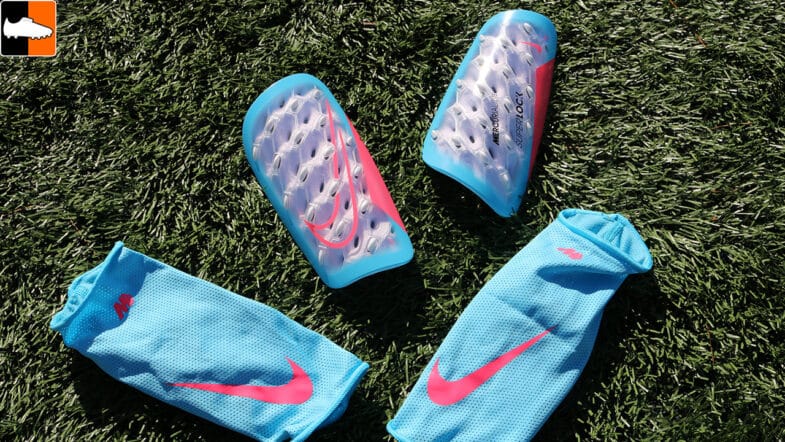
Low-profile, lightweight and built to sit under a sock without you thinking about it again once the game starts. The standard shell and perforated foam cushioning cover the essential strike zone without the bulk of an ankle guard, and Nike backs the range with a SuperLock version for players who want extra hold during sprints and direction changes.
Nike Mercurial Lite range, our top overall pick.

Mercurial Lite
Check stock↗£29.99 Low-profile, lightweight shell with perforated foam cushioning. The default recommendation on this page.

Mercurial Lite SuperLock
Check stock↗£39.99 Carved-away foam backing and SuperLock layers that press into sock fibres for extra hold during sprints and cuts.

Mercurial Lite ‘Kylian Mbappe’
Check stock↗£23.49-£32.99 Same low-profile shell as the standard pick, in the Mbappe player-edition colourway.

Mercurial Lite (Alternate Colourway)
See Nike↗See Nike A fourth Mercurial Lite variant, provides a contrast option to the usual black choice


The five picks below cover what Mercurial Lite doesn’t: a sleeve-based system without tape, the smallest verified mini pad, dedicated kids sizing, greater ankle coverage for physical football, and personalised football shin guards for players who want their own design.

AdvantEdge Aero Lite
An integrated sleeve-and-pad system with a contoured foam pad, breathable moisture-wicking sleeve and silicone grip, built to hold the pad against the shin without tape.
Who it suits: players who dislike bulky guards or the hassle of taping a slip-in in place.
It’s a sleeve-and-pad system, so if the integrated sleeve doesn’t suit your calf shape you can’t swap in a different pad.
Check stock
AdvantEdge Aero Lite 8×5cm
The smallest verified pad in the Aero Lite range, still built on the same integrated sleeve and silicone grip as the standard size, just covering a much smaller area.
Who it suits: informed players who deliberately want minimum bulk and knowingly accept less coverage for it.
Small protective area by design, not the automatic choice for children. See Mini vs Full-Size below.
Check stock
Precision Pro Matrix
Listed in three published sizes with two separate supplied sleeves, so growing children aren’t forced into one universal fit, and parents can judge coverage against actual dimensions rather than an age band alone.
Who it suits: younger players and first-time buyers where dependable fit matters more than following professional trends.
Age labels alone don’t guarantee fit, check the child’s actual shin and the sleeve as well as the shell.
Check stock
Precision Origin.0 Shin & Ankle
A conventional polypropylene shell and EVA foam backing, plus a fixed padded ankle sock that extends protection down over the ankle joint instead of stopping at the base of the shin.
Who it suits: players who want greater lower-leg coverage, including defenders and other physical players.
More warmth and bulk than a simple slip-in, and the fixed ankle sock means more to put on before every match.
Check stock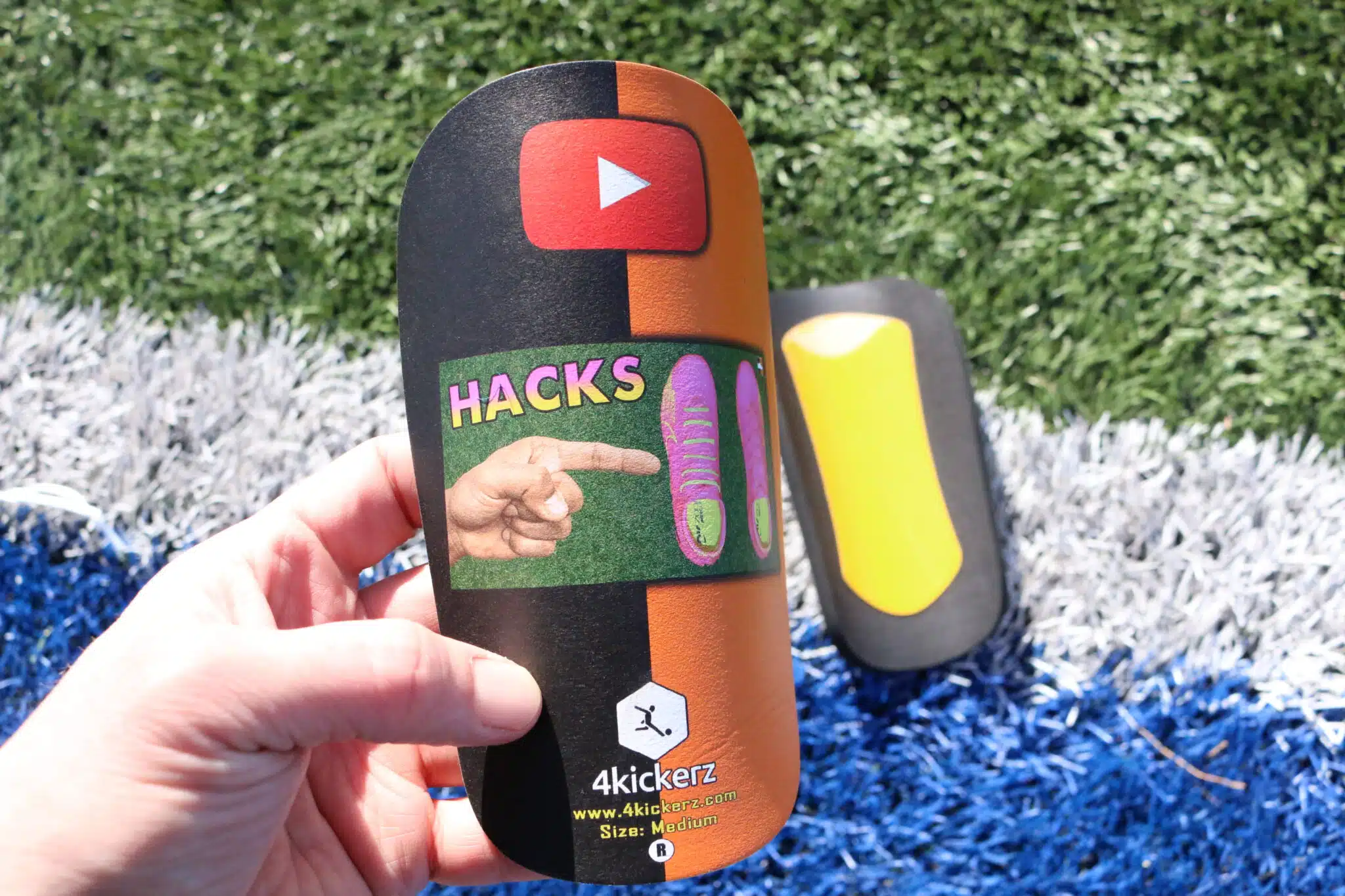
Kickson Elite Custom
Accepts photos, logos, names, numbers and flags with a digital preview before printing, built on the same flexible pad as the standard Kickson Elite in three lengths (XS, S, M) rather than one universal size.
Who it suits: players who want a distinctive design without treating personalisation as the only buying criterion.
Judge the artwork and the underlying guard separately, a beautiful print can’t compensate for poor size, comfort or retention.
Check stockThe shin pads featured here are designed and produced by their respective manufacturers. FootballBoots.co.uk is an independent, unaffiliated review site, and all opinions are our own. This page contains affiliate links, which may earn us a commission if you choose to purchase, but this does not influence our recommendations.
How To Choose The Right Shin Pads
Slip-In vs Ankle
Slip-in
A separate sleeve holds the pad against your shin. On the pitch, this is the version that disappears, low profile, minimal bulk, easy to forget you’re wearing it by the second half. The tradeoff is coverage: slip-ins protect the central shin area and not much either side of it.
Ankle guard
A single unit with an elastic wrap extending down over the ankle. You notice the extra bulk standing still, but in a genuine 50-50 challenge or a mistimed tackle, the extra coverage is doing real work the slip-in isn’t. The right tradeoff for higher-contact football, not for casual five-a-side.
Football Shin Pad Size Guide
There is no universal shin-pad sizing system shared by every manufacturer. A Medium from one brand is not guaranteed to have the same shell dimensions, sleeve fit or intended player-height range as a Medium from another.
Use the size chart for the specific product as a starting point, then compare it with the player’s actual shin and the amount of coverage wanted. Age alone is a weak guide: a tall eight-year-old and a smaller child of the same age may need different sizes, while two adults of the same height may deliberately choose different coverage.
| Check | What to look for |
|---|---|
| Player height | Useful starting point when the manufacturer sizes by height |
| Shin length | Shows how much space is available between comfortable knee and ankle movement |
| Pad dimensions | Reveals what will physically cover the leg |
| Manufacturer chart | Use the chart for that exact product and system |
| Comfort | Edges should not dig in or obstruct natural movement |
| Retention | The pad must remain positioned once the player runs and turns |
| Coverage preference | Mini and conventional guards deliberately protect different-sized areas |
For children, do not buy a much larger guard simply to leave room for growth if it currently interferes with movement or cannot be held securely. Equally, do not keep a child in an outgrown guard because the sleeve still stretches around the calf.
How to Measure for Shin Pads
You do not need a complicated fitting tool. Use a flexible tape measure or ruler and the product’s own chart:
- Have the player stand with the lower leg uncovered and relaxed.
- Identify the usable area on the front of the shin between the lower edge of comfortable knee movement and the upper edge of comfortable ankle movement.
- Measure the length of that usable shin area in a straight line down the front of the leg.
- Decide how much of it the player wants the guard to cover. This is where mini and conventional preferences produce different answers.
- Compare that measurement with the actual guard dimensions and the manufacturer’s height or size chart.
- Try the complete setup, pad, sleeve or straps, and football sock, before treating the size as confirmed.
The aim is not for the pad to fill every centimetre between knee and ankle. It should cover the intended shin area while leaving both joints free to move naturally.
How Should Shin Pads Fit?
A good fit should cover the area of shin the player intends to protect, sit comfortably against the leg, avoid the moving parts of the knee and ankle, and remain reasonably stable beneath the chosen sock or sleeve system.
Test it the way you’d test a boot: not by standing still in front of a mirror, but by doing a few sprints and cuts in training. Bend the knee and flex the ankle too. The shell should not strike the kneecap, dig into the ankle or create a sharp pressure point, and it should remain centred over the shin rather than rotating around the calf.
Pad size and retention are different problems. A perfectly sized slip-in can still move inside a loose sleeve. A tight sleeve may hold an unsuitable pad in place, but it cannot give an undersized guard more coverage or stop an oversized shell interfering with movement.
Where Should Shin Pads Sit?
Position the guard over the front of the shin, centred on the area you want covered. It should sit high enough to protect the shin rather than resting on the ankle, but low enough to leave comfortable clearance beneath the knee.
Use movement as the test rather than an unsupported universal centimetre rule. If the pad catches the knee when the player bends, presses into the ankle when running or repeatedly rotates away from the shin, adjust the position or reconsider the size and shape. Follow any design-specific manufacturer instructions.
Do You Have to Wear Shin Pads?
Wearing shin guards is mandatory in most football leagues and competitions. They’re the piece of protective equipment designed specifically to protect the shinbone from tackles, kicks and collisions, cushioning and absorbing impact to reduce bruising, cuts and more serious injuries like fractures.

Exact regulations vary by league and competition, but most require shin guards that meet minimum standards for size, coverage and construction. Even where a specific league doesn’t strictly mandate them, wearing shin guards is still strongly recommended, they meaningfully cut the risk of leg injury regardless of what level you’re playing at, from grassroots to professional.
What Happens If You Don’t Have Shin Pads?
Most leagues and competitions require shin guards as a condition of playing, and referees typically check before kickoff. If a player is found without them, or is seen removing them mid-match, play usually stops and the referee issues a warning, often a yellow card for non-compliance. In some cases the player is asked to leave the field until properly equipped, and continuing to play without shin guards after being told to fix it can result in a red card. The exact enforcement is down to the match officials, but the underlying principle across nearly every level of football is the same: shin guards aren’t optional kit.
Mini & Micro Shin Pads
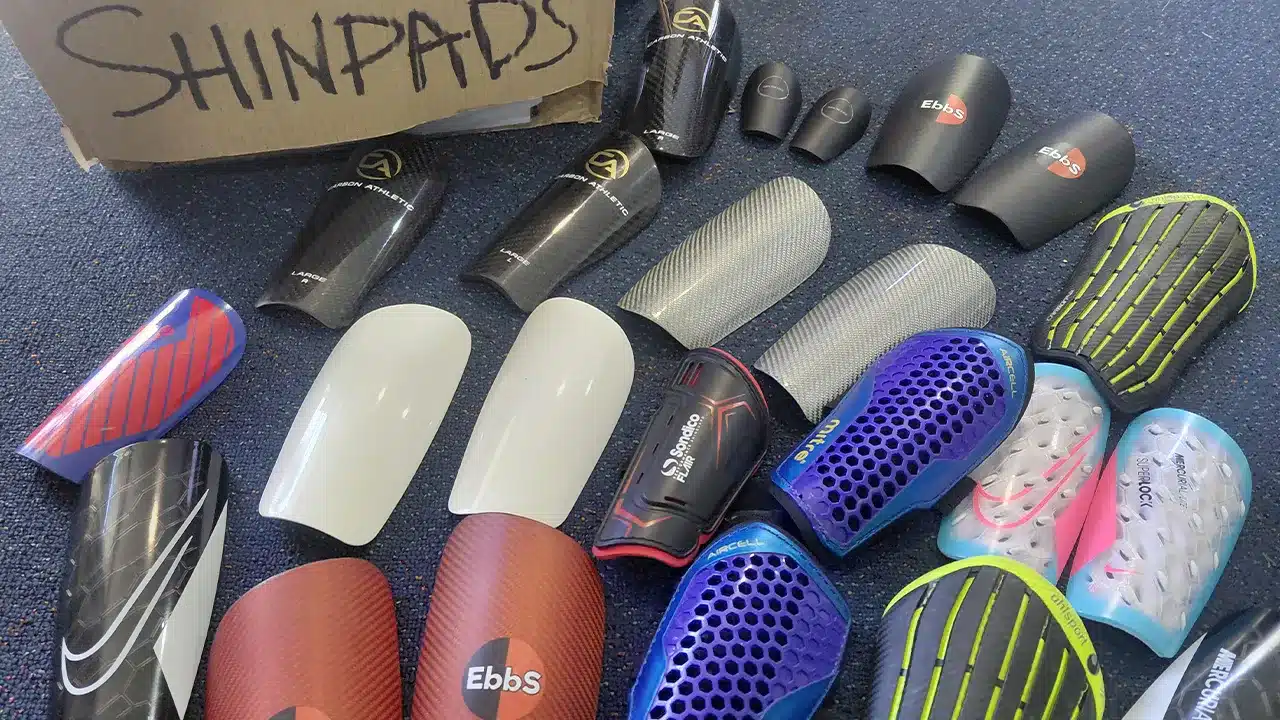
Mini shin pads cover much less area than conventional guards. “Micro” usually describes an especially small version, but there is no universal dividing measurement, so compare actual dimensions.
Players choose them for less bulk, a lighter feel, comfort and easier use with modern sock-and-sleeve setups. Professional visibility and teammate trends add to their appeal, but do not prove they suit every player.
The central trade-off cannot be designed away: a smaller protective surface covers less of the leg. That does not make mini pads useless or automatically unsuitable. It means the player needs to decide whether minimal bulk matters more than the coverage lost by reducing the pad.


Mini vs Full-Size Shin Pads
| Factor | Mini / micro pads | Conventional / larger pads |
|---|---|---|
| Coverage | Covers a small, targeted area | Covers more of the shin |
| Weight / bulk | Usually minimal | Usually greater, although thin options exist |
| Retention | Often sleeve or tape dependent | Sleeves, straps or ankle systems |
| Protection priority | Minimal feel with reduced coverage | Greater coverage with more equipment under the sock |
| Children | Requires a deliberate fit and coverage decision | Often the more straightforward starting point for younger players |
There is no universal winner. Choose mini pads if you knowingly want the lowest-profile setup and accept the smaller protected area. Choose a conventional or larger guard if useful coverage is the priority, particularly for a younger player or anyone who prefers a more substantial barrier across the shin.
Professionals wearing mini pads is a real, verifiable fact, not an urban legend. Jack Grealish is one well-known example, he wears small, junior-sized pads, a habit that started as superstition and stuck once results were good. The honest caveat most coverage of this topic skips: professionals play under closer refereeing control than most amateur football, and arguably face lower mistimed-tackle risk than a competitive Sunday league game. What works for a Premier League midfielder isn’t automatically the safest call for grassroots football.
Are Mini Shin Pads Safe?
No shin pad removes every risk. A mini guard leaves more shin uncovered, while suitability also depends on construction, fit and position. The decision is whether that particular guard provides the coverage and protection the player or parent wants.
Are Mini Shin Pads Legal?
Potentially, yes. Law 4 does not prescribe one universal minimum dimension, but requires an appropriate size to provide reasonable protection. See Shin-Pad Rules below for the full compulsory-equipment requirements and player responsibility. Permitted does not mean recommended for every child.
Should Children Wear Mini Shin Pads?
Children may want mini pads for comfort, modern sock setups or professional influence. For younger players, begin with a guard that fits, provides sensible coverage and stays comfortable. A smaller slip-in can be reasonable when it meets those requirements; there is no need for an arbitrary age ban.
If parent and child disagree, compare the options against the child’s actual shin. Seeing the uncovered area beside a conventional guard usually makes the choice clearer than debating the words “mini”, “junior” or “pro”.
Lightweight Shin Pads
Lightweight and mini are related ideas, but they are not interchangeable. A larger guard can use a thin, low-profile construction and still weigh very little. A tiny pad may be light mainly because it contains less material and covers less of the shin.
Compare weight alongside profile, coverage, comfort and retention. The best lightweight guard is not necessarily the absolute lightest; it is the option that gives the desired coverage and stays in place while remaining unobtrusive beneath the sock.
AdvantEdge Aero Lite and Kickson Elite Custom are both relevant to this category, but no performance comparison should be made until physical samples have been tested.
Shin Pad Sleeves — Are They Better?
Sleeves hold a slip-in close to the shin without repeatedly wrapping tape around the sock. The main setups are:
- Loose slip-in beneath the sock: simplest, but reliant on sock compression.
- Separate compression sleeve: flexible across pad brands, provided the calf fit is correct.
- Pocket sleeve: gives the pad a defined compartment, which must match its dimensions.
- Integrated sleeve-and-pad system: components are designed together, with less freedom to substitute another pad.
- Straps or ankle systems: secure traditional options with more material beneath the sock.
- Tape: highly adjustable, but single-use and potentially restrictive if over-tightened.
No retention system fixes a pad that is fundamentally the wrong size or shape. A sleeve should keep a suitable guard where it belongs, not disguise a poor fit.
Sleeves vs Tape
| Factor | Sleeve | Tape |
|---|---|---|
| Security | Consistent when correctly sized; poor fit can still slip | Adjustable for each use and position |
| Convenience | Pull on and reuse | Must be applied and removed each time |
| Cost / waste | Reusable | Repeated single-use purchases |
| Adjustability | Limited by sleeve size | Player controls placement and tightness |
Choose a sleeve if you want a repeatable, reusable setup and can get the fit right. Choose tape if you prefer precise adjustment or already have a pad-and-sock combination that works. Some players combine a sleeve with a small amount of tape, but adding more layers is not automatically more secure.
AdvantEdge Aero Lite: One Sleeve System, Different Coverage Choices
The current AdvantEdge product is the Aero Lite Shin Pad. It pairs an integrated sleeve with three selectable pad dimensions, 8×5cm, 10×6cm and 14×7cm, and separate Youth and Adult sleeve options. AdvantEdge describes a contoured foam pad, breathable moisture-wicking sleeve and silicone grip intended to reduce movement without tape.


That range lets players compare very small, intermediate and greater-coverage pads within the same system. The smallest may suit minimal bulk; the largest may suit players wanting the sleeve format with more coverage. The silicone grip and moisture-wicking sleeve are built to hold the pad against the shin without tape; how that stands up over a full match is something FootballBoots will confirm through its own testing, not just the manufacturer’s description.


Shin Pads For Kids
Should children wear different shin pads? Yes, and not just a smaller-sized version of an adult pad. Kids’ legs grow fast enough that a pad bought for one season often needs replacing before it wears out, school and grassroots leagues sometimes set their own minimum coverage rules worth checking locally, and comfort matters disproportionately for children, since a pad that irritates gets pushed down the sock within a few minutes of kickoff, which defeats the point of wearing one.
Best Shin Pads for Kids: A Parent’s Checklist
For children, the best guard is the one that provides an appropriate fit and useful coverage without becoming so uncomfortable or complicated that it is constantly adjusted.
Prioritise:
- Fit and coverage: suit the child’s shin rather than relying on age labels.
- Comfort: check edges, backing, straps, seams and ankle movement.
- Retention: keep the guard centred during running and turning.
- Ease of use: the child should wear it correctly with reliable help where needed.
- Protection preference: decide together whether lower bulk or greater coverage matters more.
A conventional guard is often the clearest starting point because its coverage is easy to see. Slip-ins and sleeves can also work well when properly fitted. Ankle-protection systems offer another option for children and parents who prefer more coverage and an integrated feel. Mini pads belong in the comparison, but should not win simply because they look modern.
Precision Pro Matrix: ChildrensFootball.com lists the guard in 15×5cm, 17×7cm and 19×9cm sizes, with two separate sleeves included so growing children aren’t forced into one universal fit. Three published sizes make it far easier for parents to judge coverage against their child’s actual shin than a single age-banded label.

Ankle Protection — Does My Child Need It?
Ankle-protection guards combine a shin shell with material around or beneath the ankle. They add coverage and can feel secure, but bring extra bulk, warmth and setup time.
An ankle section should not be described as guaranteeing prevention of ankle injuries. Treat it as an additional coverage and fit choice. Check that the child can run, turn and move the ankle comfortably, and that the shin shell still sits in the intended position.
Precision Origin.0 Shin & Ankle: the current retailer specification lists a polypropylene outer shell, EVA foam backing, an elastane strap and a fixed padded ankle sock, in sizes from X Small to Large. The fixed ankle sock is what separates this from a standard slip-in: protection wraps around the ankle joint itself instead of stopping at the base of the shin, which is the format to look for when ankle knocks are the concern.


What “Maximum Protection” Means in This Guide
Without comparative laboratory evidence, FootballBoots should not claim that one product absorbs a particular percentage more impact than another. Here, “maximum protection” primarily means choosing a more protective format with greater sensible coverage: a larger shell, secure positioning and, where wanted, additional ankle coverage.
The suitable option still needs to fit. The leading candidate is therefore likely to be a correctly fitted conventional guard rather than an unverified “strongest” material claim.
Precision Origin.0 Shin & Ankle is the pick because it combines a conventional shell with a fixed padded ankle sock, extending protection down over the ankle rather than leaving it exposed below a standard slip-in.
Do Defenders Need Different Shin Pads?
There is no special guard every defender must wear. Some prefer a larger, securely retained shell for frequent tackles and blocks; others choose lightweight mini pads. The better dividing line is playing style and protection preference.
If you are a defender who wants greater coverage and minimal movement, use the maximum-protection route above. If you prioritise freedom and low bulk, compare the lightweight and mini options while accepting the same coverage trade-off as any other player. That does not justify manufacturing a separate “Best for Defenders” product winner.
Personalised Shin Pads
Can personalised shin pads affect protection? No, and it’s worth answering that plainly since most personalisation marketing never actually addresses it. Custom printing is a cosmetic, print-layer process, a photo, name, number or flag applied to the outer shell. It doesn’t touch the impact-resistant shell or cushioning underneath, so a personalised pad from a reputable, certified supplier protects the same as its non-personalised equivalent.
Are Personalised Shin Pads Worth It?
They can be when the underlying guard is one you would buy without the artwork. A beautiful print cannot compensate for poor size, comfort or retention. Judge the personalisation and the shin pad separately. Before choosing a custom pad, check pad dimensions and coverage, weight and thickness, the sleeve or grip retention method, and ordering time and print durability.
Kickson Elite Custom: Personalisation Plus Product Questions
Kickson Elite Custom is the pick for Best Custom / Personalised Shin Pads because it combines a custom design service with the same flexible pad used for the standard Kickson Elite. The current product accepts photos, logos, names, numbers and flags, provides a digital preview before printing, and is offered in XS (13cm), S (15cm) and M (17cm). Kickson claims a weight of 33g per pad for size M.
The branded technology names are Kickson’s own: “4K Impact-Freeze Foam” describes the flexible foam it says compresses and disperses force on impact, “Hyper-Lock” is designed to grip the inside of the sock, and “Grip Pad” is the grip-coated surface against the leg, together intended to keep the pad seated without tape.


Grip Socks and Shin Pads
The two accessories solve different problems, and it’s worth being precise about which. Grip socks reduce your foot moving inside your boot, not your shin pad moving inside its sleeve. A genuinely loose ankle guard still needs its own strap or sleeve solution regardless of what socks you’re wearing underneath it. If you’re already sorting your grip sock setup, see our full grip socks guide for what they actually fix, and pair it with the sizing and fit advice above to get the shin pad side right too.
How to Wear Shin Pads Correctly
The setup differs by guard type, but the pad should finish centred over the shin and covered by the football sock.
- Slip-ins: place the correct side against the bare shin, centre the guard, add the chosen retention method and pull the sock over it.
- Separate sleeves: position the guard, pull the sleeve over it without folded edges, then check that the fit is firm but comfortable.
- Pocket sleeves: orient the sleeve as directed, insert the pad fully, centre the pocket and smooth any folds.
- Integrated systems: follow the product’s insertion and orientation instructions; the pad should be fully seated and the sleeve untwisted.
- Ankle-protection guards: put the foot through the ankle section, centre the shell and fasten any straps without excessive pressure or bunching.
Walk, jog and turn before play to confirm that the guard stays centred and leaves the knee and ankle free.
Do Shin Pads Go Under or Over Socks?
Shin guards are worn under and covered by the football socks. This remains true when a player uses cut match socks, grip socks or a separate shin sleeve: the guard itself must still be covered.
In a modern cut-sock setup, the grip sock covers the foot, the upper section of the match sock covers the lower leg, and a sleeve or tape may help secure the join and the shin pad. Exact layering varies, but the shin guard does not sit exposed on top of the match sock.
How to Stop Shin Pads Moving
Start by identifying why the guard moves. Adding tighter tape is not always the right first response.
Common causes include a pad that does not follow the leg, a mismatch between guard and pocket, a stretched sleeve or sock, loose straps, and poor starting position.
Try the least complicated effective solution:
- Recheck pad shape and size. A guard that rocks against the shin or cannot sit flat may never stay centred comfortably.
- Use the correct sleeve size. A compression sleeve should hold the pad close without excessive tightness.
- Match the pad to the pocket. An oversized pocket gives a small guard room to move.
- Check football-sock compression. Old, stretched socks may no longer provide useful support.
- Use tape or reusable guard stays if needed. Apply enough to secure the setup without uncomfortable pressure, and replace stretched sleeves or damaged straps.
Run, turn and strike a ball after changing the setup. A guard that stays still while standing may still move as soon as the player accelerates.
How Do Shin Pads Work with Grip Socks?
Grip socks and shin-pad sleeves solve different problems. Grip socks are designed around the foot-to-boot interface. A shin sleeve or retention system holds the guard against the lower leg.
A common arrangement is: foot → grip sock → cut lower edge of match sock / sock sleeve → shin pad and retention sleeve → upper match sock section.
The exact order around the cut edge varies, but the pad must remain correctly positioned and covered. Do not expect the grip sock itself to stop a shin pad moving higher up the leg.
What Shin Pads Do Professional Footballers Wear?
There is no single professional standard beyond satisfying the equipment requirements. Many elite players favour lightweight, low-profile or relatively small guards, while others choose larger or more traditional designs. Individual setups can also change between seasons, clubs and products.
Professional choices are interesting because they influence football style and product demand. They are not universal buying instructions. A child, grassroots player or adult prioritising greater coverage is solving a different problem from an elite player who wants the least noticeable setup possible.
Specific player examples should be used only when the guard and date can be verified. An old photograph does not establish what that footballer wears now. As the mini-pad section explains, professionals may prefer lower bulk, freedom around the leg and compatibility with their sock setup. Their willingness to accept reduced coverage does not make the smallest guard right for every player, particularly a young child.
Shin-Pad Rules: What Players and Parents Need to Know
Do Footballers Have to Wear Shin Pads?
Yes. Under IFAB Law 4, shin guards are part of a player’s compulsory equipment. They must be made from suitable material, be an appropriate size to provide reasonable protection and be covered by the socks. The player is responsible for their size and suitability.
The absence of one universal minimum dimension does not make shin pads optional. These requirements are confirmed by the current IFAB Law 4 and The FA’s publication of Law 4.
Can a Referee Stop Me Playing Because of My Shin Pads?
A match official checks that shin guards are worn and covered; the player remains responsible for size and suitability. Law 4 also allows a referee to require an equipment problem to be corrected. A player who leaves to change equipment must have it checked before returning and may re-enter only with the referee’s permission.
How to Clean and Look After Shin Pads
Care instructions vary with materials and construction, so the manufacturer’s directions take priority.
- Hard shells and slip-ins: remove mud, then wipe or hand-clean the shell and backing as directed. Do not soak layered products unless permitted.
- Foam or flexible pads: avoid aggressive scrubbing, wringing or high heat unless the instructions allow it.
- Sleeves: remove the pad where designed to separate, wash the sleeve according to its label and air it until completely dry.
- Personalised pads: avoid abrasive cleaning and follow the custom manufacturer’s method to protect the printed finish.
Dry every component fully before returning it to a kit bag.
For these products, Nike specifies hand washing for Mercurial Lite; AdvantEdge describes Aero Lite as machine washable but does not publish a cycle or temperature on the product page; Precision recommends wiping its guards with lukewarm water and drying naturally at room temperature; and Kickson recommends warm water, mild soap and air drying. Recheck the label supplied with the product before washing.
Can Shin-Pad Sleeves Go in the Washing Machine?
Sometimes, but it depends on the sleeve’s material and the manufacturer’s care instructions. Check the label or product guidance before machine washing, choosing a temperature or using a dryer. If the instructions are unavailable, do not treat any single temperature or cycle as a universal recommendation.
How Do I Stop Shin Pads Smelling?
Remove pads and sleeves from the kit bag after use. Separate removable parts, clean them as instructed and allow everything to dry fully with airflow before storage. Damp equipment left sealed inside a bag creates the conditions in which odour persists.
Wash reusable sleeves often enough for the player’s schedule. Fragrance does not replace cleaning and drying.
How Long Do Shin Pads Last?
There is no useful universal replacement timetable. Lifespan depends on the guard’s construction, frequency of use, care and whether the player is still growing.
Inspect the complete system and replace the relevant part when you find:
- a cracked, deformed or sharp-edged shell;
- compressed, separating or badly damaged foam;
- failed straps, fastenings or pockets;
- a stretched sleeve that no longer retains the guard;
- a fit the child has outgrown.
Children often need a new size before the pad itself reaches the end of its material life. Recheck fit during growth spurts rather than waiting for visible breakage.
Frequently Asked Questions
What are the best shin pads for football?
Slip-in shin pads are preferred at higher levels of football, mainly for their lightweight, low-profile fit and solid impact resistance for the coverage they give. Our overall pick on this page is the Nike Mercurial Lite, with dedicated picks by need (lightweight/sleeve-style, mini/micro, kids, maximum protection, custom) above.
What type of shin guards are best?
It depends on your level of contact. Sock-style or slip-in pads suit casual games with low injury risk. For beginners, youth players, or anyone in a higher-contact league, an ankle guard with additional elastic wrap support is the safer starting point before moving to a slip-in.
Do professional footballers wear shin pads?
Yes, they’re mandatory at every level of organised football. The pace and physicality of top-level football makes them essential, not optional, and some brands release signature colourways tied to specific players, the same way they do with boots.
Why do some football players wear small shin pads?
Some players find bulkier pads restrictive, the same reason some prefer low-cut boots to ones with an ankle collar, so they wear the smallest pad the rules allow, covering just the central shin. The tradeoff is real: less material means less coverage at the edges. It’s a genuine comfort-for-protection trade, not a loophole, and it’s a decision worth making deliberately rather than by default, see Mini vs Full-Size above.
How big should shin pads be?
Correctly sized covers from just below your kneecap to just above your ankle bone. Brands sell by height or age band as a starting point, but the real test is trying the pad through a sprint and a change of direction, not just standing still in front of a mirror.
Are mini shin pads safe?
They’re safe in the sense that they meet the same CE certification standard as full-size pads for the area they cover, they simply cover less of your shin by design. Whether that’s the right tradeoff depends on your level of contact, see Mini vs Full-Size above for the honest version of this answer.
Should children wear different shin pads to adults?
Yes. Kids’ legs grow quickly enough that pads need replacing more often, some leagues set their own coverage requirements, and comfort matters more for keeping a child willing to wear a pad properly rather than pushing it down the sock. See our Kids Guide above.
Can personalised shin pads affect protection?
No. Personalisation is a cosmetic, print-layer process that sits on top of the shell, it doesn’t replace or thin the impact-resistant material underneath. A personalised pad from a reputable, certified supplier protects the same as the same brand’s non-personalised equivalent.
Do you have to wear shin pads?
Yes, in almost all organised football. Most leagues and competitions make them mandatory, and even where a specific league doesn’t strictly enforce it, wearing them is still strongly recommended at every level.
What happens if a player doesn’t have shin pads for a match?
Referees typically check before kickoff, and a player without shin guards is usually not allowed to play until they’re properly equipped. Being caught without them, or removing them mid-match, often results in a yellow card, and continuing to ignore the rule can lead to a red.
When should a child move up a shin-pad size?
Move up when the current guard no longer provides the intended coverage, the shell or ankle section interferes because of growth, or the retention system no longer fits correctly. Use the next product-specific size chart and test the complete setup; do not size up solely because of age.
Can I use the same shin pads for training and matches?
Yes, provided they remain suitable, are worn correctly and meet the competition requirements. A separate match pair is optional.
Should I buy two pairs of shin pads?
One suitable pair is enough for many players. A spare can help with frequent training, tournaments, wet kit, travel or lost equipment.
Are shin pads different for artificial and natural grass?
The surface does not usually change the buying decision: fit, coverage, comfort and retention still matter. Wet or muddy conditions mainly affect cleaning and drying.
What about shin pads for futsal or indoor football?
Check the rules for the exact format and competition. The FA’s futsal Law 4 requires shin guards to be covered entirely, made from an approved material and provide a reasonable degree of protection. Local indoor or small-sided competitions may use different regulations.
Do shin pads prevent injuries?
Shin pads provide a protective barrier against impacts to the area they cover, but they cannot eliminate the risk of injury. Pad construction, coverage, fit and position all matter. Any stronger claim about preventing a particular injury or reducing risk by a measured amount requires authoritative evidence.
Sorting the rest of your kit?


