

Metal stud football boots are made for soft, wet and muddy natural-grass pitches where shorter moulded studs cannot get enough bite. Brands normally label them Soft Ground (SG), although you may also see SG-Pro, MxSG, MIX or SI depending on the manufacturer and stud configuration.
The quick rule is simple: if the pitch gives way underfoot and a longer stud can sink into it, SG may be right. If the studs cannot penetrate the surface, do not wear them.
Our top all-round pick: the Nike Phantom 6 Low Elite Soft Ground combines a more natural-shaped toe box, wet-or-dry Gripknit touch and a circular traction layout for players who want a balanced premium boot rather than the narrowest speed fit.
Looking for the studs rather than the boots? This page compares complete soft-ground boots. For replacement metal or plastic studs, stud keys, lengths and compatibility, use our Replacement Football Studs guide.
Nine current SG boots are ranked and compared below.
See the best SG boots ↓Playing somewhere else?
Wet grass, but still firm underneath?
Rain alone doesn’t make a pitch Soft Ground. If the surface still supports your weight and long studs don’t sink in, that’s a Firm Ground call, not SG. See the Firm Ground guide →
Playing on 3G/4G artificial grass?
Long-pile artificial grass has an even, resilient base that needs its own soleplate, not metal studs. See the Artificial Grass guide →
Playing on short traditional astro or turf?
Short, carpet-like AstroTurf over a hard base needs a flat TF soleplate, metal studs aren’t suitable and are often prohibited. See the Artificial Grass and Astro/Turf guide →
Playing indoors on a hard court?
Flat, non-turf indoor floors need a flat IC sole, not studs of any kind. See the Futsal and Indoor guide →
Editor’s verdict
For most players, a metal-stud boot should be a specialist second pair, not the only boot in the bag. It earns its place when a natural-grass pitch is genuinely soft enough for long studs to penetrate. On a firm base, the same studs can feel harsh and unstable underfoot; on artificial grass they can be unsuitable, prohibited and damaging to the surface.
Do not buy from the upper alone. First choose the right soleplate, then the fit and feel you want: nine current SG boots are ranked, compared and picked apart below. Picks are based on current manufacturer specifications, surface classification, differentiation and UK availability, not invented wear-testing; fit notes carried over from my own testing are flagged as personal experience rather than manufacturer fact.
Don’t assume Nike Elite automatically means Anti-Clog. The current Vapor 17, Phantom 6 and Tiempo Maestro Elite SG models don’t carry an Anti-Clog claim, while their Academy SG equivalents do. We’ve marked Anti-Clog availability in the comparison below.
Best Metal Stud Football Boots: SG and SG-Pro
Best picks at a glance
Best Metal Stud Football Boots 2026
Ranked by soleplate fit for purpose, not price tier
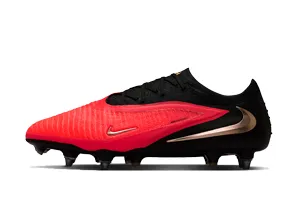
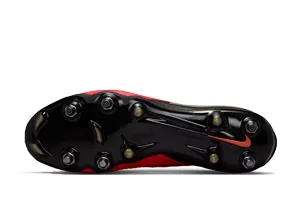
Nike Phantom 6 Low Elite
Flyknit and Gripknit construction wraps around the foot rather than compressing it, with a more natural toe-box shape than previous Phantom generations.
Check stock at Nike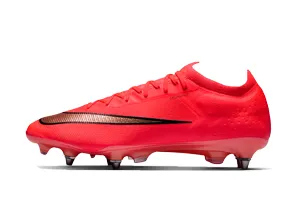
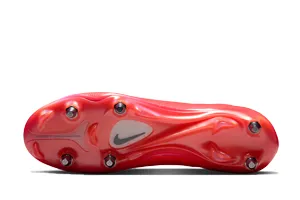
Nike Mercurial Vapor 17 Elite
Ultra-thin Atomknit upper and FlyLite plate keep this the lightest boot on the page, with mixed conical and bladed metal studs for wet, muddy pitches.
Check stock at Nike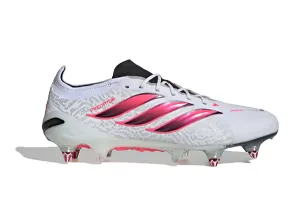
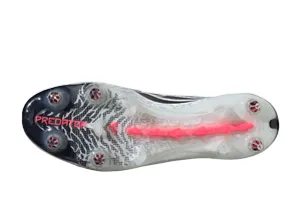
adidas Predator Elite
Built for a structured, control-first touch, with removable studs, spares and a wrench supplied so a lost stud doesn’t end your session.
Read the full Predator review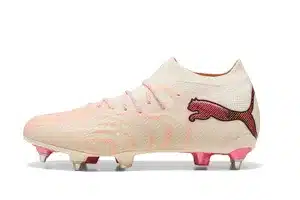
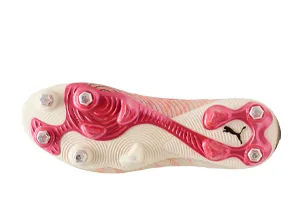
Puma Future 9 Ultimate
A wider, more forgiving fit for feet that find Nike and adidas speed lasts too narrow, with a plate built to move freely through turns rather than straight lines.
Read the full Future 9 review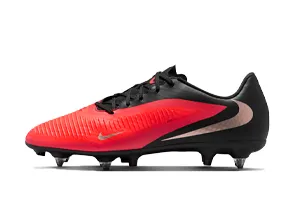
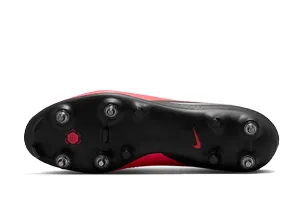
Nike Phantom 6 Low Academy
The mud-shedding Anti-Clog soleplate the pricier Elite Phantom above doesn’t carry, so your studs keep biting on a badly cut-up pitch, at a fraction of the price.
Check stock at Nike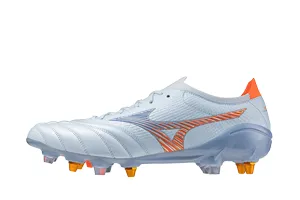
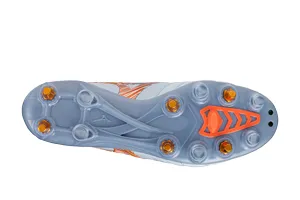
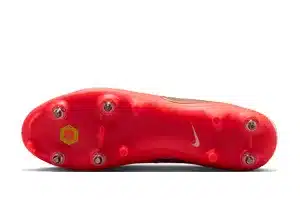
Mizuno Morelia Neo IV Beta MIJ
Genuine leather that breaks in and shapes itself to your foot match by match, for players who want that old-school touch rather than a synthetic wrap.
Read the full Morelia Neo review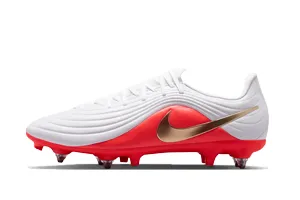
Nike Tiempo Maestro Academy
Anti-Clog keeps the plate clear on a muddy pitch, on a softer, more forgiving touch than Phantom’s control-first last.
Check stock at Nike
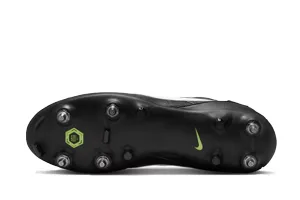
Nike Premier 3
A traditional leather feel for players who never got on with knitted uppers, with Anti-Clog built in despite the old-school SG-Pro name suggesting otherwise.
Check stock at Nike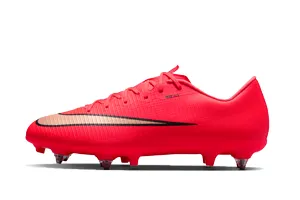
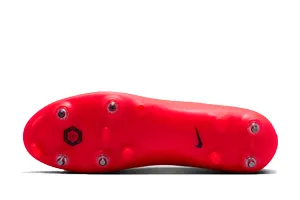
Nike Mercurial Vapor 17 Academy
The narrow, speed-focused Vapor fit with Anti-Clog thrown in, for players who rate keeping their studs clear above Elite-level materials.
Check stock at NikeFull comparison
| Pick | Soleplate | Best for | Fit | SG configuration | Anti-Clog | Studs removable |
|---|---|---|---|---|---|---|
| Nike Phantom 6 Low Elite | | Balanced touch and fit | True-to-size, natural toe box | Mixed conical/bladed metal | No | Not specified |
| Nike Mercurial Vapor 17 Elite | | Lightweight speed | Narrow, speed-focused last | Mixed conical/bladed metal | No | Not specified |
| adidas Predator Elite | | Striking-focused control | Regular fit | Removable metal studs | No | Yes, with spares and wrench |
| Puma Future 9 Ultimate MxSG | | Accommodating playmaker fit | Regular to wide | MxSG mixed/soft plate | No | Not specified |
| Nike Phantom 6 Low Academy | | Mud and Anti-Clog value | Academy, true-to-size | SG-Pro Academy plate | Yes | Not specified |
| Mizuno Morelia Neo IV Beta MIJ | | Premium leather touch | Low-profile Mizuno last | SG Mix soleplate | No | Not specified |
| Nike Tiempo Maestro Academy | | Comfort-first Anti-Clog | Soft, adaptive FlyTouch | Removable steel-tipped studs | Yes | Yes |
| Nike Premier 3 SG-Pro | | Traditional leather value | Classic, true-to-size | Fixed conical traction | Yes | No |
| Nike Mercurial Vapor 17 Academy | | Speed-focused Anti-Clog | Narrow, speed-focused last | Academy SG plate | Yes | Not specified |
1. Nike Phantom 6 Low Elite Soft Ground
The Phantom 6 Low Elite is the strongest all-round recommendation for players who want premium touch without committing to the very snug profile of a pure speed boot. Nike’s current SG version uses Gripknit across the striking area, which the brand says maintains grip in wet or dry conditions, while its revised frame creates a more natural toe-box shape than previous Phantom generations.
Why the traction pattern matters
The circular Cyclone 360 traction pattern is designed around planting and pivoting. That makes this a sensible premium choice for midfielders, forwards and defenders who value clean changes of direction as much as straight-line acceleration.
Midfielders, forwards and defenders who value clean changes of direction and a natural-shaped toe box over the narrowest possible fit.
- Natural-shaped fit rather than a narrow speed last
- Wet-or-dry Gripknit touch zone
- Pivot-friendly circular Cyclone 360 traction
- Premium price
- No current product-page Anti-Clog claim, see pick 5 for the Academy Anti-Clog alternative
2. Nike Mercurial Vapor 17 Elite Soft Ground
The current Vapor 17 Elite SG moves the Mercurial recommendation on from the outgoing Vapor 16. Nike pairs an ultra-thin Atomknit upper with its FlyLite plate, then uses a combination of conical and bladed metal studs at the heel and forefoot for wet, muddy pitches.
Vapor vs Superfly
This is the pick for players who want their SG boot to retain a light, close-to-ball speed-boot character. It also preserves a useful choice: pick the low-cut Vapor if you prefer the traditional Mercurial shape, or the related Superfly if you actively want the collar.
Players who prioritise low weight and a snug, close touch over a roomier fit.
- Ultra-thin Atomknit upper
- FlyLite plate keeps weight down
- Mixed conical/bladed metal studs for wet, muddy pitches
- Snug fit, Nike advises half a size up for more room
- No current Anti-Clog claim on the Elite product page
3. adidas Predator Elite Soft Ground
The latest Predator Elite SG is the clearest choice for players who want adidas’ control-and-striking package on a soft-ground soleplate. The current model combines a Nanostrike+ mesh upper with Powerspine support and a Strikeframe outsole.
Why the removable hardware matters
Most importantly for this page, adidas explicitly supplies the boot with removable studs, spare studs and a stud wrench. That makes the hardware easier to maintain than a fixed-metal setup and gives the buyer a brand-supported starting point if a stud is lost.
Players who want a structured, control-and-striking package and don’t mind a regular-fit last.
- Nanostrike+ control-focused upper
- Powerspine support and Strikeframe outsole
- Removable studs, spares and a wrench supplied
- Regular fit will not suit every foot
- Regular fit runs narrower than PUMA or Nike’s wide options
4. Puma Future 9 Ultimate MxSG
PUMA calls this soleplate MxSG, meaning it is intended for mixed and soft natural surfaces. The FUTURE 9 ULTIMATE combines that plate with an adaptive FUZIONFIT upper, targeted 3D grip zones and midfoot PWRTAPE support.
Fit and outsole detail
The official fit is described as regular to wide, which makes the FUTURE a useful alternative to narrow-feeling speed boots. Its FLEXGILITY outsole uses a circular layout designed for agile, multi-directional movement rather than reproducing a traditional six-stud pattern.
Wider-footed players who find Mercurial and Vapor speed lasts too narrow.
- Official regular-to-wide fit
- Adaptive FUZIONFIT upper
- Circular FLEXGILITY plate for multi-directional movement
- MxSG is a mixed/soft configuration, not a deep traditional six-stud plate
5. Nike Phantom 6 Low Academy Soft Ground
The Phantom 6 Low Academy SG-Pro answers the question the Elite Phantom 6 SG above cannot. Nike’s current product description confirms Anti-Clog traction for this soleplate, at a fraction of the Elite’s price, on a lighter NikeSkin upper built around clean, close-contact striking rather than the Elite’s Gripknit touch zone.
The Elite vs Academy naming pattern
Current UK retailer listings badge the Phantom 6 Elite Soft Ground as a “Player Edition” rather than an Anti-Clog model, the same naming pattern used on the current Tiempo Maestro Elite SG. That’s my own observation from checking live retailer listings, not a quoted Nike statement, but it fits a broader pattern: Anti-Clog has receded from Nike’s newest flagship SG soleplates while remaining on the equivalent Academy models.
Players on genuinely muddy, badly drained pitches who want the mud-shedding soleplate more than the Elite upper.
- Anti-Clog confirmed in Nike’s current product description
- A fraction of the Elite Phantom price
- NikeSkin upper built for clean, close-contact striking
- Academy materials and finish, not Elite-level Gripknit or Cyclone 360 traction
6. Mizuno Morelia Neo IV Beta MIJ
For players who still want natural leather in a modern lightweight shape, Mizuno’s current Morelia Neo generation is the premium option here. Mizuno builds it Made in Japan with a low-profile last and a soft-ground-rated outsole for natural grass.
Full spec detail
The current Neo IV Beta Made in Japan Mix brings K-leather with an updated rearfoot knit, a collar built 5mm higher than the previous generation, a redesigned eyelet arrangement and a nylon and TPU-resin external-counter outsole on the SG Mix soleplate, with a new sockliner lining underfoot.
Players who want genuine leather touch and don’t mind paying for Made in Japan construction.
- Premium leather touch
- Close, low-profile Mizuno last
- Soft-ground-rated outsole for natural grass
- High price
- Stock can be limited
- Longer break-in period than synthetic uppers
7. Nike Tiempo Maestro Academy Soft Ground
The Tiempo Maestro Academy SG is one of the clearest current value choices because Nike explicitly combines removable steel-tipped studs with Anti-Clog traction. The FlyTouch upper is designed to feel soft, adapt to the foot without overstretching and provide consistent touch in wet or dry conditions.
The trade-off
It will not reproduce the material quality of a top-tier boot, but it gives grassroots players the feature that matters most on badly maintained muddy pitches: a current, manufacturer-confirmed Anti-Clog soleplate at an Academy price.
Players who want Anti-Clog on a softer, more forgiving touch than Phantom’s control focus.
- Anti-Clog soleplate confirmed in Nike’s current product description
- Soft FlyTouch upper
- Removable steel-tipped studs
- Academy materials and finish rather than Elite specification
8. Nike Premier 3 SG-Pro
The Premier 3 remains available in the UK and offers a different proposition from modern knitted and thin synthetic boots. Its real-and-synthetic leather upper, conical traction and optional cut line on the fold-over tongue give it a familiar, traditional feel.
The SG-Pro naming trap
Worth knowing: Nike currently calls this model SG-Pro while explicitly advertising Anti-Clog traction, so don’t treat “SG-Pro” as a universal synonym for “no Anti-Clog” or “professional-only”.
Players who want classic leather and current Anti-Clog support without paying Elite prices.
- Supple leather upper
- Classic fold-over tongue
- Current Anti-Clog claim confirmed
- More traditional build, not the lightest or thinnest option
9. Nike Mercurial Vapor 17 Academy Soft Ground
Vapor 17 Academy SG puts Nike’s speed-focused last and lighter Atomknit-style upper on a soleplate that Nike’s current product description confirms carries Anti-Clog, at a fraction of the Elite SG price.
The Academy trade-off
It follows the same Academy pattern as the Phantom 6 and Tiempo Maestro picks above: pay less, get Anti-Clog, accept Academy rather than Elite materials.
Players who want Vapor’s narrow, speed-focused fit on muddy pitches and rate Anti-Clog above Elite-level materials.
- Anti-Clog confirmed in Nike’s current product description
- Vapor’s narrow, speed-focused last
- A fraction of the Elite Vapor price
- Academy materials and finish, not Elite-level Atomknit or FlyLite plate
Comparing full reviews rather than just the soft-ground picks?


What are Soft Ground football boots?
Soft Ground football boots are built for wet, muddy natural grass that is soft enough for longer studs to penetrate. Their studs are normally longer and fewer than those on an FG, AG or TF soleplate. Many use removable aluminium studs or steel-tipped studs; others combine metal traction elements with shorter moulded studs.
The aim is not simply “more grip”. It is the right type of grip for a yielding surface. A longer stud can pass through loose topsoil and reach a firmer layer below. On genuinely soft ground this can improve purchase and reduce the amount of surface sliding compared with a shallow moulded plate.
That same geometry is wrong when the pitch is hard. If a long stud cannot sink in, the contact is concentrated under fewer points and the boot may feel raised, harsh or unstable. The surface, not the weather forecast or month of the year, decides whether SG is appropriate.
What do SG, SG-Pro, MxSG, MIX and SI mean?
These labels are useful, but they are manufacturer terms rather than one universal industry standard.
| Label | Practical meaning | Important qualification |
|---|---|---|
| SG (Soft Ground) | The broad category for wet, muddy natural grass | Check the actual plate: removable, fixed, full-metal and mixed configurations all exist |
| SG-Pro | A brand/model label commonly associated with a mixed soft-ground plate | Not a controlled standard; Nike currently uses it on the Anti-Clog Premier 3 |
| MxSG | PUMA’s current mixed/soft natural-ground label | Intended to cover mixed and soft natural surfaces; compare stud length for very deep mud |
| MIX | Mizuno’s mixed soft-ground configuration | Mizuno lists current MIX products under Soft Ground for natural grass |
| SI | A Mizuno label seen on more traditional replaceable-stud soft-ground options | Configuration varies by model; inspect the sole image and product specification |
Do not buy from the acronym alone. Look at the underside of the exact boot and ask:
- Are the metal studs removable or fixed?
- Is it a traditional sparse layout or a mixed plate with shorter moulded studs?
- Does the manufacturer name wet, muddy natural grass as the intended surface?
- Are replacement studs and the correct wrench available for that exact model?
SG vs SG-Pro: which configuration is better?


There is no automatic winner.
Traditional sparse metal-stud layouts
A six- or eight-stud plate creates fewer, deeper contact points and can suit very soft, heavily churned natural grass. It can also create more noticeable stud pressure underfoot, especially as the pitch firms up.
Mixed SG / SG-Pro layouts
A mixed plate combines metal studs with shorter moulded elements. It spreads contact across more points and can feel closer to a familiar FG soleplate on a good-quality wet grass pitch. It may not penetrate a severely muddy surface as aggressively as a sparse plate with longer studs.
A mixed, “pro-style” plate can suit maintained professional-quality grass, while a more traditional setup can still make sense on a deeply muddy grassroots pitch. Treat that as a pitch-and-player judgement, not a claim that professionals universally prefer one plate.
How many studs do Soft Ground boots have?
There is no longer one correct number. Traditional SG boots were commonly built around six screw-in studs, four in the forefoot and two in the heel, but current products use a much wider range of layouts.
Current layouts include:
- traditional sparse replaceable-stud plates;
- mixed plates with six metal studs plus smaller moulded studs;
- PUMA MxSG circular layouts;
- New Balance’s current 12-stud Furon Elite SG configuration;
- Nike mixed conical and bladed metal layouts;
- Mizuno MIX and SI variants.
Stud count is therefore less important than penetration, pressure distribution, release and manufacturer-rated surface.
Nike Anti-Clog traction: what it does and who needs it
On a genuinely muddy pitch, mud packs around the studs and across the plate itself. It adds weight, and once enough has built up it stops the studs penetrating cleanly. Anti-Clog is Nike’s answer to that specific problem: an adaptive polymer soleplate coating that works with water rather than repelling it, creating a slicker surface mud struggles to hold onto. Nike introduced it in 2016.
On a well-drained professional pitch this barely matters. On a badly maintained grassroots pitch with more mud than grass, it can matter more than any upper technology on the boot, arguably a bigger practical difference than the knit, the plate or the price tag.
How Nike’s use of Anti-Clog has changed
I’ve followed Anti-Clog since it launched, and its position within Nike’s SG range has moved. It began as a premium, Elite-level technology, and early versions applied the coating much more extensively across the soleplate. Over the generations since, Nike has progressively pulled back how much of the plate carries it. My reading, from following the products rather than from any Nike statement, is that weight is the main driver: a full-coverage Anti-Clog plate adds mass Nike’s fastest Elite boots are otherwise built to shed.
The counter-intuitive 2026 situation
Do not assume that paying more for a current Nike Elite SG boot gets you Anti-Clog. It does not automatically. Nike’s current Elite Soft Ground flagships, Mercurial Vapor 17, Phantom 6 and Tiempo Maestro, do not carry an Anti-Clog claim on their current product pages, and UK retailers consistently list the Phantom 6 and Tiempo Maestro Elite SG soleplates as a “Player Edition” rather than an Anti-Clog one. The current Mercurial Vapor 17 Academy SG, Phantom 6 Low Academy SG-Pro and Tiempo Maestro Academy SG-Pro, by contrast, all carry Anti-Clog, confirmed in Nike’s current product description for each, at a fraction of the Elite price.
That is the opposite of how the technology started, as something that set the premium boot apart, and it is genuinely useful to know before you spend Elite money assuming it buys you the mud-shedding soleplate as well.
Mercurial Vapor 17 fits the same Academy pattern as Phantom and Tiempo Maestro: the Elite SG tier does not carry Anti-Clog, but the Academy SG version does, confirmed in Nike’s current product description. If Anti-Clog matters more to you than the Elite upper and touch, Vapor 17 Academy SG is the boot to check first.
What should you actually buy?
Let the pitch decide, not the price tier:
- Want Nike’s premium upper and touch, and mud is a minor issue on your pitch? An Elite SG boot is still the right call, just do not buy it expecting Anti-Clog.
- Play on a genuinely sticky, badly drained pitch where mud is the main problem? The Phantom 6 Low Academy or Tiempo Maestro Academy, both confirmed Anti-Clog, are the more rational buy, even against a boot costing two or three times as much.
- Not actually playing on soft, muddy natural grass? Anti-Clog will not help either way. Check whether Firm Ground, Artificial Grass or Turf is the right surface first.
Practical Anti-Clog care
Wetting the Anti-Clog soleplate before stepping onto a muddy pitch is consistent with the water-responsive design: give the clean sole a light rinse or pour a little clean water across it before use. Do not describe this as a magic “activation”, and always follow any care instructions supplied with the boot.
After play, rinse mud away with cool or lukewarm water and a soft cloth or brush. Avoid scraping the coated plate with sharp tools or wearing it across abrasive concrete, sand or artificial surfaces.
Are metal football studs removable?
Many are, but not all metal traction elements are user-replaceable.
It varies by brand:
- adidas’ current Predator Elite SG explicitly includes removable studs, spares and a wrench;
- Nike’s Tiempo Maestro Academy SG uses removable steel-tipped studs;
- some modern mixed plates use fixed metal-tipped elements;
- other boots combine removable metal studs with permanent moulded studs.
Check the product description and the physical stud head before applying a wrench. Never force a fixed stud.
For replacement sets, lengths, tools and model compatibility, go to the Replacement Football Studs guide. That page owns the parts question; this page owns complete metal-stud boots.
Can you replace metal studs with plastic studs?
Only when the boot manufacturer or replacement-stud supplier explicitly confirms compatibility with the exact boot, thread and intended use.
Changing the material of a removable stud does not automatically turn an SG boot into an FG, AG or TF boot. The plate geometry, stud positions, remaining fixed elements and outsole construction do not change. In particular, plastic replacement studs are not a licence to take an SG soleplate onto artificial grass.


Use brand-approved parts where possible, match the stated front/rear lengths, and never assume that all screw-in football studs share one thread. See Replacement Football Studs for the detailed compatibility check.
A practical pre-match check
Walk onto the pitch in trainers or moulded boots before changing. Press a thumb or spare stud into an undisturbed area near the touchline without damaging the surface. If the ground is soft enough to accept a longer stud and your moulded boots are slipping, SG is the likely match. If the ground resists penetration, use FG instead.
Pitch condition can change across a season and even across one field. A waterlogged goalmouth does not automatically make the whole pitch suitable for the longest studs. If you regularly play on variable natural grass, carry both FG and SG pairs and decide at the venue.
Can you wear SG boots on firm ground?
No, not when the ground is firm enough to resist the studs.
Long metal studs are designed to enter soft soil. On a hard pitch they can leave the foot perched on a small number of pressure points, feel uncomfortable and create an unstable platform. Move to a manufacturer-rated Firm Ground boot instead.
If the grass is wet but the soil remains firm, it is still usually an FG decision. Wet is a clue; softness is the test.
Can you wear FG boots on Soft Ground?
An FG boot can cope with slightly damp natural grass if the base remains firm. It becomes the wrong tool when the pitch is genuinely soft and the shorter moulded studs cannot reach stable ground.
If you are sliding, the surface is moving beneath your plant foot and an SG stud can penetrate safely, change to SG. Do not try to convert an ordinary fixed-mould FG soleplate by swapping studs, it does not have removable studs. Permanent soleplate conversions are specialist modifications and sit outside normal manufacturer guidance.
Can you wear metal studs on artificial grass or AstroTurf?
No. Metal SG boots are made for yielding natural soil, not a synthetic carpet and constructed base.
On artificial grass, long metal studs may fail to release as intended, can damage the pitch and are prohibited by many facilities. The Football Foundation also advises avoiding metal-stud boots on 3G surfaces. Use the specific Artificial Grass or Astro/Turf guide to choose between AG and TF footwear, and check the venue’s footwear rules before arriving.
For indoor hard courts, use flat, non-marking Futsal or Indoor football shoes.
Are metal studs allowed in football?
The Laws of the Game require footwear and say a player must not use anything dangerous; they do not impose a universal ban on metal studs. The referee, competition and venue can still reject footwear that is sharp, damaged, unsafe or unsuitable for the pitch.
Before every match:
- check for burrs, sharp edges and badly worn tips;
- make sure removable studs are secure and none are missing;
- confirm the competition and venue footwear policy;
- accept the referee’s equipment decision.
The same principle applies to youth football. Do not assume that “metal is legal” means every league, school or facility permits every metal-stud boot.
How to care for metal stud football boots
Soft-ground boots need more attention than a fixed moulded pair because mud and moisture collect around the hardware.
- Remove heavy mud after the match. Knock off loose soil gently and use a soft or medium brush around the soleplate. Avoid striking coated Anti-Clog plates together aggressively.
- Clean by hand. Wipe the upper with mild detergent and water, following the material-specific instructions supplied by the brand. Do not submerge the whole boot.
- Clear the stud seats. With removable studs still fitted, brush mud away from the edges so dirt is not driven into the thread when you next remove them.
- Air-dry at room temperature. Remove the insoles and laces if needed, stuff the boots with paper and keep them away from radiators, hair dryers, tumble dryers and direct heat.
- Inspect when dry. Check every removable stud for wear, damage and movement. Tighten with the correct wrench until secure, but do not overtighten.
- Carry spares. Keep the correct front and rear replacements plus the right stud key in your boot bag.
- Keep them off hard walkways. Change at the pitch edge; concrete and tarmac wear metal tips and concentrate pressure underfoot.
Frequently asked questions
What does SG mean on football boots?
SG means Soft Ground. It is the manufacturer surface category for soft, wet and muddy natural-grass pitches. It does not mean artificial grass, turf or any wet surface.
Are metal studs better than moulded studs?
Only on the right pitch. Longer metal studs can penetrate soft soil more effectively; moulded FG studs are normally better when natural grass is firm. AG and TF soleplates are designed for their own synthetic surfaces.
Is SG-Pro better than SG?
Not automatically. SG-Pro is not a universal performance grade. It often describes a mixed soft-ground configuration, but current use varies by brand and model. Choose by pitch condition and exact plate, not the suffix.
Do all Soft Ground boots have metal studs?
Metal or metal-tipped traction is common, but the layout and construction vary. Some have removable aluminium studs, some removable steel-tipped studs, some fixed metal elements and some mixed metal/plastic configurations.
Do all Nike SG boots have Anti-Clog?
No, and in 2026 it works the opposite way to how most buyers assume. Nike’s current Elite Soft Ground flagships, including Vapor 17, Phantom 6 and Tiempo Maestro, do not currently make an Anti-Clog claim, while the Mercurial Vapor 17 Academy, Phantom 6 Low Academy and Tiempo Maestro Academy all do. Check the exact product page or box rather than assuming it from the Nike silo, Elite tier or SG label.
Should I wet Nike Anti-Clog before playing?
A light rinse of the clean soleplate before a muddy match is a sensible practical step because the adaptive surface is designed to work with water. Follow the care label and avoid abrasive cleaning.
Can I use rugby studs in football boots?
Only if the boot or stud manufacturer explicitly confirms the exact thread, dimensions and intended football use. A stud that screws in is not necessarily a safe or correct match. Never improvise with unknown lengths or damaged hardware.
How tight should screw-in studs be?
They should be fully seated and secure with the correct stud key, without being forced or overtightened. Recheck them after cleaning and before each match.
Why can I feel the studs under my feet?
Some stud pressure is more noticeable on sparse SG plates because body weight is spread across fewer contact points. If it becomes uncomfortable, the pitch may be too firm, the stud length may be unsuitable, or the boot may not fit correctly.
Do professional footballers wear SG or SG-Pro boots?
Professionals use a range of soft-ground configurations, often influenced by pitch preparation, personal preference and custom equipment. Their setup is not proof that the retail equivalent is right for a grassroots pitch. Choose from the condition under your own feet.
Should I buy SG boots as my only pair?
Usually not in the UK unless you play almost exclusively on soft natural grass. An FG pair plus an SG pair covers changing grass conditions more safely and comfortably. Players who also use synthetic or indoor venues need the appropriate AG, TF or IC footwear as well.
Related guides
- Playing on ordinary natural grass? See the Firm Ground and Multi-Ground guide.
- Playing on 3G, 4G or short-pile astro? Choose with the Artificial Grass and Astro/Turf guide.
- Playing on a sports-hall floor or hard court? See Futsal and Indoor football shoes.
- Need new screw-ins, a stud key or a compatibility check? Use the Replacement Football Studs guide.
- Still comparing every outsole? Read the Football Boot Soleplate guide.
