

The adidas F50 is built for players whose value comes before they receive the ball.
The F50 gets you to the ball first. The Phantom helps you use it in tight space. The Predator is about what you decide to do with it once it is yours.
The F50 is adidas’ dedicated speed silo, the modern successor to the X line and the adiZero F50 that once held the “lightest boot in football” title (see the best selling football boots ranking for where it sits today).
Quick verdict
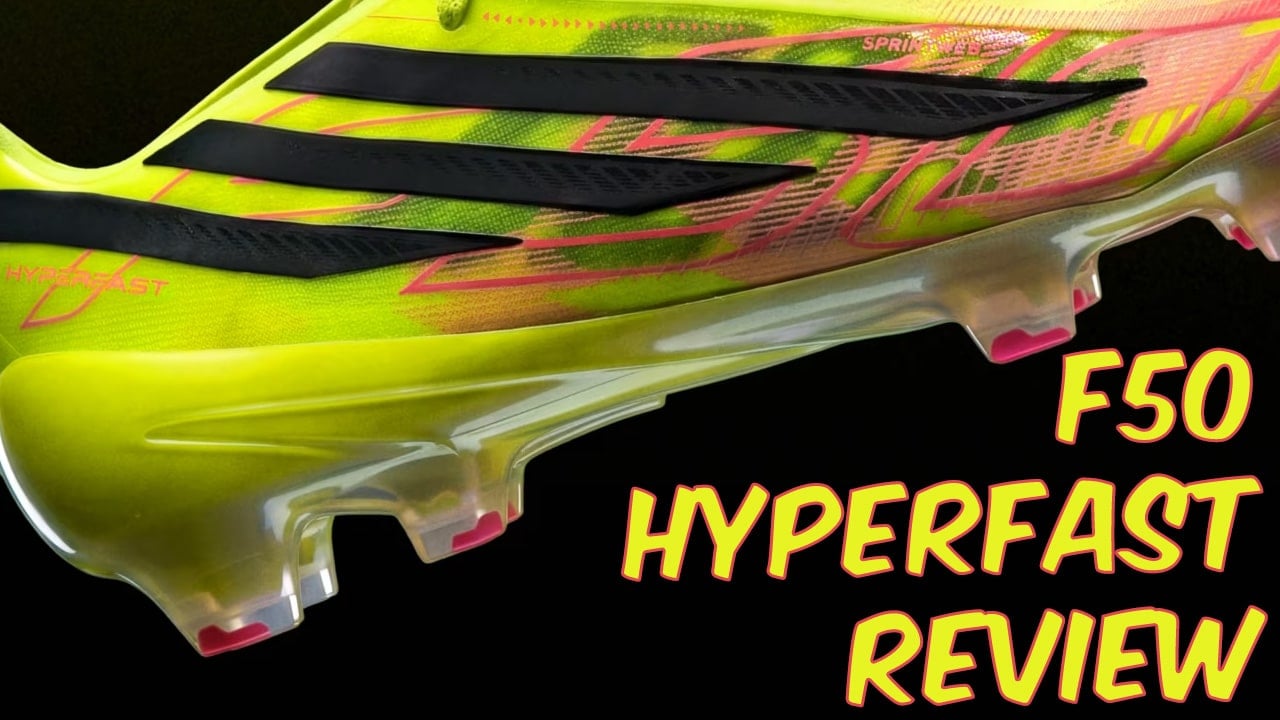
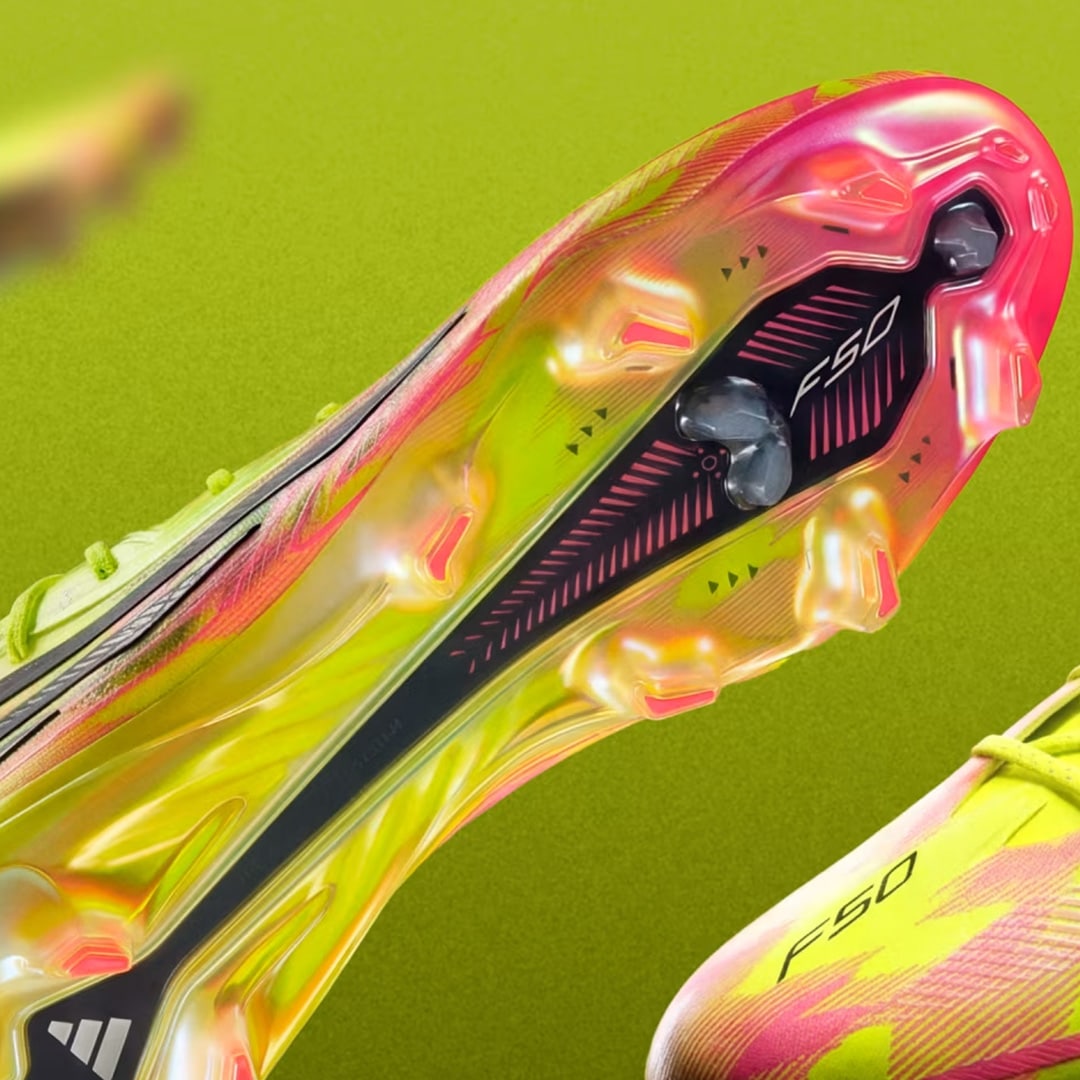
After testing the F50 Hyperfast Elite across matches and training, what stands out is how naturally it lets you play at speed. It is extremely light, but the point is what that lightness lets you do: accelerate, carry the ball, change direction and take touches on the move without feeling like the boot is slowing you down.
The upper has a thin, close-to-foot feel that keeps contact with the ball clean and predictable, while the soleplate gives you enough structure and bladed traction to stay secure when you cut inside or change direction. It feels fast without being harsh, which makes it easier to carry the ball at pace than some of the more rigid speed boots.
This review covers the current adidas F50 Hyperfast, the generation introduced in 2026, tested in laced Elite spec. It is more built-up than the old adiZero F50. The F50 Cage+ structure gives the midfoot real support and the Speedsystem+ plate is firm through the middle, so the boot feels planted rather than flimsy. The trade for that is fit: the shape is lean, the forefoot tapers and the midfoot wraps tight, so wider feet need to think carefully before buying.
If your game is acceleration, direct running and attacking space, the F50 Hyperfast Elite is one of the most convincing boots in the current adidas range. If you value a soft, cushioned touch or you spend most of a match circulating possession at a slower tempo, its speed-first character works against you.
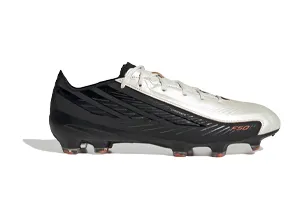
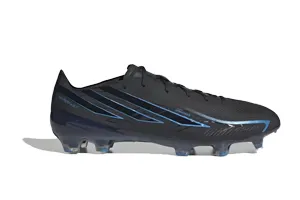
Current F50 Hyperfast Elite colourways, newest first.
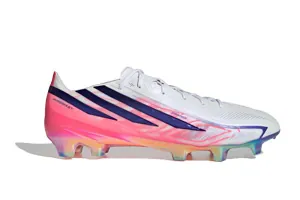
Chaos vs Control
Check stock↗Part of the adidas pack for the opening of the 2026/27 season
The adidas F50 is designed and produced by adidas. FootballBoots.co.uk is an independent, unaffiliated review site and every opinion here is our own. This page contains affiliate links that may earn us a commission if you buy through them; that never influences the review. Written and tested by Dean Ariola, FootballBoots.co.uk’s Chief Writer, who bought this pair with his own money.
| Football identity | Value before you receive: acceleration, carrying into space, changing direction at pace |
|---|---|
| Best for | Wingers, wide and advanced forwards, attacking full-backs, ball-carrying number 8s |
| Fit | Lean and streamlined. Regular volume, tapered forefoot, secure midfoot wrap. Not a wide-foot boot; the laced Elite is the adjustable one |
| Weight (per boot, FG) | Elite laced ~179g · Elite laceless ~170g · EVO ~130g · League ~200g |
| Stud options | FG and AG, bladed speed tooling. Not interchangeable for regular use |
| Range | Elite (laced and laceless), EVO, Pro, League, Club |
| Where it sits | adidas’ speed silo, successor to X and the adiZero F50 (see our best selling football boots ranking) |
Football identity: what the F50 is for
Every major silo solves a different football problem. The F50 is for players whose value comes before they receive the ball. The Phantom is for players whose value comes after they receive it. The Predator is for players who decide what happens next.
The F50 rewards movement. It is at its best when you get the ball and immediately have somewhere to go: attacking the full-back, bursting into the space behind a defender, driving through midfield, overlapping from deep. It is not built to help you dominate the ball while standing still. It is built to give you the freedom to move quickly once you have it.
That is why the honest players for it are attackers who use pace as their main weapon. It does not magically make you faster; it removes enough of the material between your foot and the ground that playing quickly feels natural.
Identity
For players whose value comes before they receive the ball: the ones running the channels and attacking space rather than holding the ball up.
Football problem it solves
How do I accelerate, carry the ball into space and change direction at pace without the boot getting in the way?
Best match moments
- Receiving with space ahead of you
- Taking on a full-back one on one
- Chasing a through ball on the shoulder
- Braking, planting and going again
- Breaking on the counter-attack
adidas F50 Hyperfast — buy it or not
- Your game is acceleration, direct running and attacking space
- You are a winger or wide forward who attacks the full-back one on one
- You are a forward who runs the channels rather than playing target man
- You are an attacking full-back who overlaps hard and has to recover
- You have narrow to standard feet and want a refined, secure speed boot
- You spend most of a match shielding, holding up or circulating possession
- You want a soft, plush, cushioned touch above all else
- You have genuinely wide or wide, flat feet (look at the EVO first)
- You dislike aggressive bladed studs
- You want the lightest possible boot regardless of structure (that is the EVO)

Who this boot is for
The common thread across these roles is using movement to create an advantage.
Attacks the full-back one on one and cuts inside at speed. Direct touch, acceleration and traction suit repeated changes of pace.
Starts wide and makes diagonal runs behind the defence. The light feel makes it easy to carry into the final third before shifting direction or shooting.
Runs beyond the defensive line rather than playing target man. Built for repeated off-the-shoulder runs and chasing through balls in transition.
Overlaps aggressively and sprints back. The low weight helps over repeated up-and-down runs; the traction helps when turning to recover.
Receives deeper and drives forward with the ball rather than circulating. The direct touch makes it easy to take a touch into space and accelerate.
On the pitch
| Situation | Rating | What you notice |
|---|---|---|
| Counter-attacking | 10/10 | Space opens, you take a touch and go. Nothing feels bulky under the foot. |
| Attacking space | 9/10 | Easy to build momentum and keep carrying without feeling weighed down. |
| Taking on defenders | 9/10 | Solid platform to push against when you drop a shoulder and accelerate away. |
| Repeated acceleration over 90 minutes | 9/10 | The low weight tells most when you sprint again and again. |
| Receiving at speed | 8/10 | Direct connection with the ball, so a first touch into space is easy to judge. |
| Changing direction | 8/10 | Bladed studs bite on the plant; the structured midfoot keeps the boot from feeling too flexible. |
| Striking on the run | 8/10 | Predictable contact, helped by the Sprintweb+ texture. |
| Close control and shielding in tight areas | 5/10 | Not what it is for. The direct upper gives clarity, not cushioning. |
Attacking space
This is where the F50 feels most at home. Receive the ball with space ahead and the light build makes it easy to build momentum quickly and keep carrying without feeling weighed down. Winger, forward or a midfielder driving into the gap, the boot encourages you to keep moving forward rather than slowing the play.


Taking on defenders
The F50 is effective in one-on-ones where you change speed and direction repeatedly. The stiff midfoot and bladed studs give you a solid platform to push against when you drop a shoulder, cut inside or accelerate away, and the upper feels secure enough that your foot is not moving around inside the boot. It is most useful attacking from wide areas, where a quick change of direction followed by another burst matters more than the softest possible touch.
Receiving at speed
An underrated strength. The thin upper gives you a direct connection with the ball, so a first touch into space is easy to judge and follow immediately with another movement. Chasing a through ball or taking a pass on the move, the boot feels predictable rather than padded or springy.
Changing direction
Not just straight-line running. The soleplate is useful when you brake, plant and go again: the bladed studs bite on the push-off and the structured midfoot stops the boot feeling too flexible through the sharper movements. That gives the F50 a more planted feel than its weight suggests, which suits wingers and attacking midfielders who constantly switch between acceleration and deceleration.

Counter-attacking
Few situations suit the F50 better. When possession turns over and space opens up, you can take a touch forward, accelerate into the gap and carry the ball without the boot feeling bulky. The direct upper helps when you have to make a decision at full speed, whether that is shifting onto your stronger foot, playing across the defence or taking the shot yourself.


Technology translation
Four technologies define the Elite. Here is what each one actually changes when you play. adidas uses two names for the upper system, F50 Skin+ and Haloskin+; they are the same thing.
A very thin engineered textile that sits close to the foot. Contact with the ball is clean and immediate; a first touch at speed is easy to judge. The precision-grip coating adds a little friction for dribbling without becoming sticky.
- Taking a first touch into space at pace
- Carrying the ball on the dribble
- Making a decision at full speed
A 3D textured surface across the strike zone. It gives the upper a bit more feel and friction on the ball when you are moving quickly, so driven passes and shots on the run land more consistently than off a slick synthetic.
- Striking on the run
- Playing a driven pass across the defence
A TPU support structure through the midfoot plus a compression tongue that wraps the foot. This is what stops such a light boot feeling flimsy: plant hard to change direction and the midfoot holds its shape and your foot stays anchored.
- Planting to cut inside
- Braking and immediately changing direction
- Repeated hard changes of direction
A lightweight speed plate with aggressive bladed studs and a stiff core through the midfoot. Strong push-off, quick acceleration and confident bite when you cut. Firm rather than springy, so it feels like a stable platform to move off.
- Accelerating from a standing start
- Pushing off to cut past a defender
On the studs and surfaces: the bladed speed tooling gives excellent bite, but it is aggressive. Players who prefer a rounded, rotational stud pattern may find it sharp. For regular play on modern 4G, buy the AG version. Our artificial grass boots guide covers why FG and AG are not interchangeable.


Fit, shape and lockdown
| Length | True to adidas length for narrow to standard feet. Do not size up just because it feels tight; you gain length before width. |
|---|---|
| Width | Lean and tapered. Streamlined forefoot, secure midfoot wrap, a little extra room at the toe. Not a wide-foot boot. |
| Volume | Regular overall, but foot volume matters as much as width. High-volume feet feel the midfoot squeeze. |
| Wide or flat feet | Be cautious with the Elite. The EVO’s more pliable upper accommodates width better; try it in your normal size. |
| Lockdown | Excellent on the laced Elite: laces, adaptive tunnel tongue and structured midfoot hold the foot through acceleration and cuts. |
| Laced vs laceless | Laced is adjustable and the safe choice. Laceless gives a cleaner striking surface and a sock-like fit but no adjustment. Choose laced unless you know laceless suits your foot. |
| Break-in | Short. Enough underfoot cushioning to stop the light build feeling harsh. |


Read the full fit and sizing detail
The F50 Hyperfast Elite has a performance shape that sits close to the foot without being aggressively narrow everywhere. adidas calls it a regular fit, which is fair on overall volume, but the shape is streamlined: the forefoot tapers towards the toes and the midfoot has a noticeably secure wrap. It feels more restrictive on wider or higher-volume feet than “regular fit” suggests, especially through the midfoot, where the structure gives you excellent lockdown but little spare room. There is a touch more length at the end of the toe box than the silhouette implies, so the F50 is best described as lean rather than short or extremely narrow.
Foot volume matters almost as much as width. A relatively wide but low-volume foot may find the F50 easier than a high-volume foot that needs room across the midfoot. Do not automatically size up because the boot feels tight: you can add length at the toes without gaining the width you actually need. Start at your usual adidas size if your foot is narrow to standard.
For wide feet, be more cautious. The F50 can take some width once the upper settles, but it is not shaped around a broad foot, and there are recent owner reports of the Elite feeling too narrow for genuinely wide feet. If your feet are wide and flat, check the midfoot rather than just the toe box. A boot can have an acceptable toe box while still compressing the foot across its widest point, and that is the area to worry about with the F50. Our wide football boots and narrow football boots guides go deeper.
The laces are the Elite’s biggest fit advantage. Adjustable instep tension lets you loosen the forefoot, tighten the midfoot or keep the heel secure without making the whole forefoot too tight. That is why the laced Elite is the safest F50 for most players. The laceless Elite keeps the same streamlined character but removes that adjustment, so it has to fit your foot from the outset; owner feedback on it is mixed. The EVO is the most forgiving of the three: a thinner, more pliable upper with a standard tongue and deeper lacing opens up more easily across the forefoot, which makes it the better bet for wide, flat feet.
Where the F50 sits now
The F50 has had one of the least straightforward histories of any speed boot. adidas did not land on the lightweight formula immediately: the early boots experimented with heavier construction and interchangeable parts, the adiZero years turned extreme weight reduction into the boot’s identity, and then the name disappeared for almost a decade while the X line carried the same speed idea forward under a different badge.
Bringing the F50 back in 2024 was a return to a name that had become shorthand for adidas speed. The Hyperfast is the second generation of that revival, and it is the point where adidas has stopped chasing the lowest possible number on the scales and started building a speed boot with real structure. The Elite still feels light and direct, but it also has lockdown, a firm plate and a considered touch, which makes it usable as an everyday match boot rather than a specialist tool you switch to for one game.
The complete F50 and the version this review is based on. Laced and laceless, plus the ~130g EVO.
Check the Elite at adidas ↗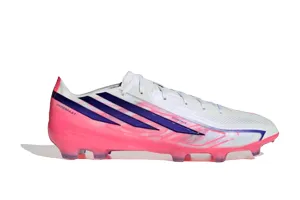
Much of the Elite’s upper feel for less. The value pick in the range.
Check the Pro at adidas ↗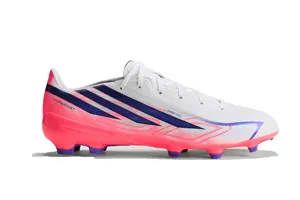
Light and recognisably F50 at a sensible price, for occasional and developing players.
Check the League at adidas ↗Weaknesses and tradeoffs
No boot does everything, and the F50 makes clear choices.
Think twice if: you play a slow, possession-heavy game; you want a cushioned touch above all; you have genuinely wide or flat feet; you dislike bladed studs; you want maximum comfort over responsiveness.
How it compares
The honest cross-brand comparison is against the other current speed boots. All four are speed boots, but they are not four versions of the same idea.
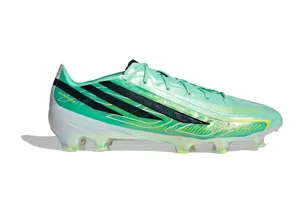 F50 Hyperfast Elite
|

|
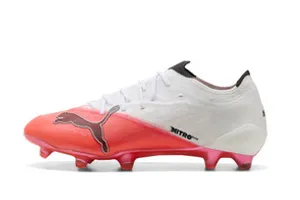 Ultra NITRO 7
|
 Furon 9 Elite
|
|
|---|---|---|---|---|
| Weight (approx, per boot) | ~179g | ~155g | Mid | ~176g |
| Character | Most balanced all-rounder | Most stripped-back, agility-first | Speed with cushioning underfoot | Traditional secure feel, modern speed |
| Upper | F50 Skin+, thin and direct with light texture | Atomknit, extremely thin, barefoot | Softer ULTRAWEAVE | One-piece mesh with TPU film |
| Underfoot | Firm Speedsystem+ plate, planted | Very thin FlyLite plate, minimal | PEBA plate plus NITROFOAM ELITE, livelier | Speed Ctrl studs, balanced flex and hold |
| Wide or flat feet | Cautious (laces help) | Least accommodating | More accommodating | More accommodating |
Where the other silos take you
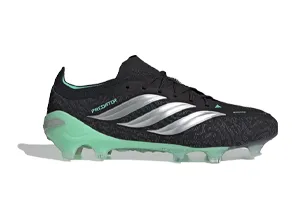
Choose if your value comes after you get the ball: controlling tempo, distributing, striking through it.
Read the Predator review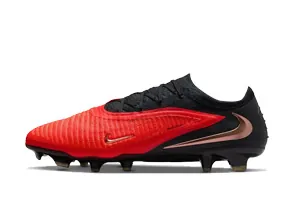
Choose if your value comes in congestion: turning, combining, solving tight areas.
Read the Phantom 6 review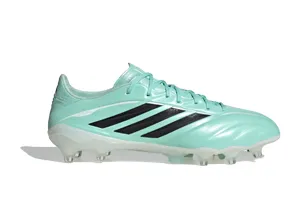
Choose if you want a soft, natural, cushioned touch over an active performance surface.
Read the Copa reviewRead the full comparison breakdowns
F50 vs Mercurial Vapor 17
The Vapor is the more extreme lightweight boot at around 155g, with an Atomknit upper that feels wrapped around the foot rather than built around it. It has the edge for pure agility and barefoot sensation: constant weight shifts and changes of direction in tight space feel very natural. The F50’s extra structure makes it feel more dependable when you are repeatedly planting and pushing off, and its fit is a touch more manageable. Full detail in our Nike Vapor review.
F50 vs Puma Ultra NITRO 7
Puma took a different route: rather than chasing minimum weight it built NITROFOAM ELITE into the footbed, so there is more cushioning and rebound underfoot. The Ultra feels like it wants to launch you forward; the F50 feels like a stable platform you move off yourself. The Ultra is the one to look at if you normally find speed boots too harsh.
F50 vs New Balance Furon 9
The Furon 9 moved to a one-piece engineered mesh with TPU film, so it is sharper and more direct than the soft V8. It sits between the F50 and Ultra in personality: lightweight and responsive, but with a more conventional, secure football-boot feel and less of the ultra-minimal sensation. A good choice if you want speed without the stripped-back feel.
For wide, flat feet
Look at the Ultra NITRO 7 and Furon 9 first, then the F50; the Vapor 17 needs the most caution. The F50 EVO is also worth considering if you want adidas, because its more pliable upper is more accommodating than the structured Elite.
Which F50: Elite, laceless, EVO, Pro, League or Club
Two questions here: which version of the Elite, and how far down the range to go.
Elite, laceless Elite or EVO
The laced Elite (~179g) is the complete F50: F50 Skin+ upper, F50 Cage+, Sprintweb+, the Speedsystem+ plate, a cushioned sockliner and the adaptive tunnel tongue. Thin and direct, but with real midfoot structure and a firm plate, and the adjustable lacing makes it the safe choice for most feet. This is the version this review is based on.
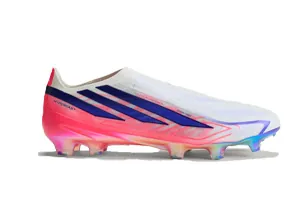
The laceless Elite (~170g) is technically almost identical to the laced Elite, just without the laces. A completely clean striking surface and a sock-like fit, only slightly lighter. Choose it for the feel, not for speed, and only if you already know laceless boots fit your foot, because there is no way to adjust it.
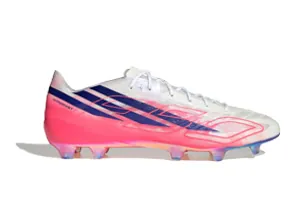
The EVO (~130g) is not an Elite with grams shaved off. It is a different, more minimalist construction: Haloshell EVO mesh, a lighter cage, no precision-grip layer, a floating tongue. Your foot feels almost directly under the ball and quick movements feel very immediate. The trade is less midfoot structure and stability, so it asks more of the player when the game slows down. It is also the most forgiving of the three for wide, flat feet.
Recommendation: the laced Elite for the best balance and a full season. The EVO if minimum weight is your priority, or if you have wide, flat feet. The laceless Elite if you love laceless boots and know the fixed fit suits you.
The complete F50 and the version this review is based on. Best upper, best lockdown, firmest plate, most refined touch, and the adjustable lacing that makes it work for the widest range of feet. Around 179g.
Technically almost identical to the laced Elite, just without the laces. A completely clean striking surface and a sock-like fit, only slightly lighter at ~170g. Choose it for the feel, and only if you already know laceless boots fit your foot.
Not an Elite with grams shaved off. A different, more minimalist construction: Haloshell EVO mesh, a lighter cage, no precision-grip layer, a floating tongue. An almost barefoot connection to the ball and very immediate quick movements, but less midfoot structure and stability. The most forgiving of the three for wide, flat feet.
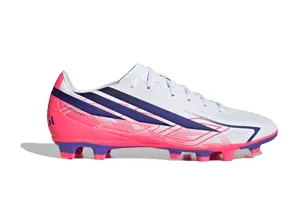
Most players should buy the laced Elite for the best balance. Take the EVO only if minimum weight is your priority or your feet are wide and flat. Down the range, the Pro is the value pick: much of the Elite’s upper feel for a less refined plate. League and Club give you the idea of the F50 rather than the flagship. If you can still find your size, a discounted previous-generation F50 Elite (the 2024 revival) is often a better buy than a current Pro or League.
The value sweet spot. It carries much of the Elite’s upper feel (Haloskin+, Haloshell+, Halocage+), and independent comparisons rate the upper close to the Elite. The main compromise is a less sophisticated, more flexible soleplate, which some players actually prefer, and it runs marginally wider through the midfoot.
A more obvious step down at around 200g. Still light and recognisably F50, but the upper is more substantial and less crisp, and the foot is held less precisely. Good for occasional play or developing players; do not expect Elite responsiveness.
Judge it differently. A simpler synthetic upper and basic soleplate, heavier and less refined. Sensible for a young player, casual football or anyone who goes through boots quickly. You are buying the F50 identity, not a scaled-down flagship.

adidas F50 Hyperfast FAQs
| Question | Short answer |
|---|---|
| Is the adidas F50 Hyperfast a good speed boot? | Yes, one of the more complete ones. It combines a light build with a thin, direct upper, strong lockdown and aggressive traction, which suits acceleration, carrying the ball at speed and changing direction. |
| Is the F50 Hyperfast good for wide feet? | Be cautious with genuinely wide or wide, flat feet. The Elite has a lean, close-fitting shape that can feel restrictive through the forefoot and midfoot. The laces help you adjust, but sizing up adds length before width. The EVO is the one to try first because its more pliable upper accommodates different shapes better, though it is still not a genuinely wide boot. |
| Does the F50 Hyperfast fit true to size? | Start at your normal adidas size. Shape matters more than the size recommendation: narrow and standard feet are usually fine at their usual size, wider or higher-volume feet may need to experiment. Do not size up or down without thinking about your foot shape. |
| Is the F50 Hyperfast comfortable? | Yes, for a speed boot. Not plush or heavily cushioned, but with enough underfoot cushioning to keep the light build from feeling harsh. Responsive first, comfortable second. |
| Does the F50 Hyperfast have good lockdown? | Yes, one of the Elite’s strongest points. The laces, adaptive tunnel tongue and structured midfoot hold the foot through acceleration, planting and changes of direction. The laced Elite adjusts more precisely than the laceless. |
| What is the F50 Hyperfast like to play in? | Light, direct and planted. The upper keeps you close to the ball; the soleplate gives you plenty of bite when you accelerate or cut. Most enjoyable when you are constantly moving rather than playing slow, possession football. |
| Is the F50 Hyperfast good for wingers? | Yes, arguably where it makes the most sense. Low weight, direct touch and aggressive traction suit players who attack space, carry at speed and take defenders on one on one. See our best boots for wingers guide. |
| What is the difference between the F50 Elite, Pro, League and Club? | The Elite is the most refined and complete: best upper, lockdown and soleplate. The Pro keeps much of the Elite’s upper character and is the best value. The League is more basic but still light. The Club is an affordable entry-level option. |
| F50 Hyperfast Elite vs EVO: which is better? | Neither outright. The Elite gives you more structure, stability and refinement. The EVO is far lighter and more stripped-back. Choose the Elite for most players, the EVO if minimum weight is the priority or you have wide, flat feet. |
| F50 Hyperfast Elite vs laceless: which should I buy? | The laced Elite is the safer choice because you can adjust the fit and lockdown. The laceless is for players who prefer a clean, uninterrupted upper and already know a fixed laceless fit suits them. It is only slightly lighter, so choose it for feel, not speed. |
| Is the F50 Hyperfast good for artificial grass? | Yes, on the AG soleplate. FG and AG are not interchangeable for regular use. If most of your football is on 4G, buy the AG version. See our artificial grass boots guide. |
Every adidas F50 generation
The F50 arrived in 2004 ahead of Euro 2004. The “F” is for Fast and the “50” nods to the 50th anniversary of West Germany’s 1954 World Cup win in adidas boots. What followed took the boot from an experiment to the definitive lightweight silo.
Structure returns to the lightweight idea. F50 Skin+, Sprintweb+, F50 Cage+, Speedsystem+. Light and direct, but with real lockdown and a firm plate.

The name comes back after almost nine years, replacing X. Engineered textile upper, Sprintframe 360 plate, compression midfoot tongue. Messi and Lamine Yamal on the billing.

The F50 name is retired; the X silo carries the speed philosophy through X 15, 16, 17, 18, 19, Ghosted, Speedflow, Speedportal and Crazyfast.

HybridTouch with SpeedFoil on a SprintFrame outsole. The adiZero Crazylight pushes weight-saving further and becomes Gareth Bale’s boot.

The boot most people mean by “F50”. 165g at launch, marketed as the world’s lightest. Single-layer SprintSkin, SprintFrame outsole, triangular studs. The Prime drops to around 150g; the miCoach version puts a data chip in the boot.

The thin SprintSkin synthetic arrives and pushes the F50 towards its lightweight future. Messi wears fixed-stud customs, scores in the 2009 Champions League final and famously kisses the boot after losing it in the celebration.

Modularity taken to its limit: swap the upper, soleplate and studs. Ambitious, and heavier than the speed boots that followed.

A more substantial upper, a split TRX outsole, interchangeable insoles. Introduced as adidas’ answer to the Nike Mercurial.
The X years fill the gap between the adiZero F50 and the 2024 revival.
Final verdict
adidas F50 Hyperfast — FootballBoots Verdict
Buy it if
- You are a winger or wide forward
- You are a forward who runs the channels
- You are an attacking full-back
- You are a ball-carrying midfielder
- You have narrow to standard feet and want a refined speed boot
Avoid it if
- You are a possession player who works at a slower tempo
- You want a soft, cushioned touch above all
- You have genuinely wide or flat feet
- You dislike aggressive bladed studs
Read the full final verdict
The F50 Hyperfast Elite is at its best when your next action involves movement: running beyond the defence, attacking a full-back, carrying into space, receiving while already moving, changing direction at speed. It does not make you faster by itself, but it removes enough of the usual distractions between your foot and the ground that playing quickly feels natural.
For most players I would choose the laced Elite over the EVO and the laceless. The EVO’s extra lightness is a genuine sensation, and it is the one to try first if you have wide, flat feet, but you give up structure, stability and a refined touch for it. The laceless is a cleaner striking surface and a sock-like fit, not a faster boot. The laced Elite gives you the best balance without asking you to make a major compromise, and the adjustable lacing means it works for the widest range of feet.
Down the range, the Pro is the value pick: most of the Elite’s upper feel for a less refined plate. The League and Club give you the idea of the F50 rather than the full flagship.
If your game is acceleration, direct running and attacking space, the F50 Hyperfast is one of the most convincing boots adidas makes right now. If you value softness, cushioning and a relaxed touch, its speed-first character stops being an advantage.
