

The New Balance Tekela v5 is built for the player who wins the ball back before anyone notices they’ve lost it.
Where the Furon feels sharp, direct and built for attacking open space, the Tekela is softer and calmer, favouring close control and movement through tighter areas.
See how it fits into the wider silo on our New Balance football boots page.
My quick verdict
During training and match play, it felt most convincing when receiving under pressure, turning and moving the ball quickly. It is not as aggressive or immediately responsive as the Furon, but its pliable feel and smooth movement make it the more natural choice for players who value touch, comfort and control.
The switch from Hypoknit to Dynamic TouchTech gives the Tekela v5 a noticeably different touch on the ball. Debossed channels and small grip-print elements provide subtle haptic feedback rather than aggressive traction, and lockdown is better than the pliable upper might suggest, thanks to the one-piece collar and the deep, anatomically shaped heel doing most of the work.
Check the Tekela v5 at New Balance
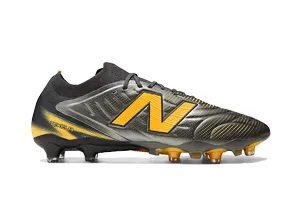
The softest, most refined upper and the build this review is based on.
Check the Elite at New Balance ↗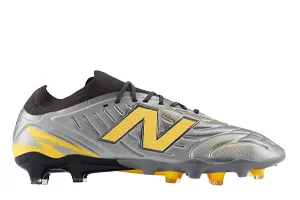
The strongest value in the range, nearly all of the Elite experience.
Check the Pro at New Balance ↗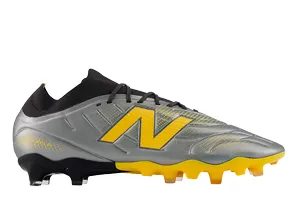
A respectable recreational option on a tighter budget.
Check the Team at New Balance ↗New Balance Tekela v5: pros and cons
Pros
- Soft and pliable upper requires very little break-in.
- Sculpted heel and Hypoknit collar provide dependable lockdown.
- Standard fit accommodates several foot shapes, with a genuine 2E option.
Cons
- Grip texturing is helpful but much subtler than the Predator or Phantom.
- Soft upper can flex during especially forceful cuts.
- Low toe-box height may press against high-volume feet.
FootballBoots.co.uk is an independent, unaffiliated review site, and all opinions in this review are our own. This page contains affiliate links, which may earn us a commission if you choose to purchase, but this does not influence our reviews. This review is by Dean Ariola, FootballBoots.co.uk’s Chief Writer, who tested the Tekela v5 on the pitch.
| Football identity | Close control and movement through tight areas, calmer than the Furon |
|---|---|
| Best for | Central midfielders, number tens and wide creators who receive between opposing lines, and forwards who drop to link play |
| Fit | Anatomical, close through the heel and midfoot, more accommodating forefoot. True to size, with a genuine 2E option |
| Sizing | True to size for narrow, average and mildly wide feet. Genuinely wide or flat feet should look for the 2E version rather than sizing up |
| Surface | FG best on natural grass. Use the dedicated AG or HG version on synthetic pitches |
| Range | Elite, Pro and Team |
| Worn by | Endrick, giving the Tekela an explosive attacking identity |
| Where it sits | New Balance’s control silo, alongside the Furon and the 442 |
Football identity: what the Tekela v5 is for
In keeping with New Balance’s fit-first identity, the Tekela v5 offers a distinctly different experience from the Furon. Where the Furon feels sharp, direct and built for attacking open space, the Tekela is softer and calmer, favouring close control and movement through tighter areas. It is not as aggressive or immediately responsive as the Furon, but its pliable feel and smooth movement make it the more natural choice for players who value touch, comfort and control.
New Balance Tekela v5: buy it or not
- You want a soft, direct touch with very little break-in
- Your game is receiving under pressure, turning and quick combinations
- You value secure heel lockdown over a rigid midfoot
- You want a 2E option for wider feet
- You play mostly on natural grass
- You want the Furon’s sharper, more aggressive speed-boot feel
- You have a high-volume foot and the low toe box bothers you
- You want a rigid, tightly braced midfoot for hard cuts
- You want strong grip like a Predator or Phantom
- You play mainly on artificial grass

Who the Tekela v5 is for
Regularly receives between the lines, where the soft touch and subtle texturing help control a firm pass under pressure.
Progresses the ball through close control and quick combinations rather than raw pace.
Drops towards the ball, protects possession and brings teammates into play rather than constantly running behind the defence.
This is for the technical player who values a soft upper, direct touch and fluid movement over aggressive ball grip or explosive soleplate energy. Players who prefer a rigid midfoot, forceful straight-line traction or a highly spring-loaded plate will probably feel more at home in the Furon or another dedicated speed boot.
What it feels like on the pitch
Receiving and turning under pressure
The Tekela v5 is at its best collecting the ball in crowded areas. Its thin, pliable Dynamic TouchTech upper gives a clear sense of the first contact, while subtle texturing provides just enough friction cushioning or rolling the ball. The conical studs release smoothly as you turn away from pressure.
Quick combinations
Short passes, lay-offs and one-touch exchanges suit the Tekela particularly well. The upper feels consistent across the foot, letting the ball move cleanly without an overly sticky grip element interrupting the touch. It complements quick decision-making rather than attempting to manufacture control for you.
Changing direction in tight spaces
The mixture of conical studs and angled forefoot rim studs creates a useful balance between rotational freedom and lateral bite. This works well carrying the ball through half-spaces, shifting onto the opposite foot or making repeated direction changes. It is less convincing during pure straight-line acceleration, where the Furon gives a sharper, more aggressive platform.
Fit and feel
| Length | True to size. The main restriction comes from the relatively low toe box rather than width. |
|---|---|
| Width | Anatomical shape sitting close through the heel and midfoot before a more accommodating forefoot. Pliable enough to settle around moderately wide feet. |
| Best foot shape | Narrow, average and mildly wide feet fit true to size most comfortably. |
| Wide or flat feet | Look for the 2E wide version where available rather than sizing up, which adds unnecessary length and makes the fit less precise. |
| High-volume feet | The upper can press against the tops of the toes because of the relatively low toe box. |
| Break-in | Very little. Dynamic TouchTech is already soft and flexible out of the box, normally needing only a short session to settle. |
Sizing. The Tekela v5 fits true to size, with an anatomical shape that sits close through the heel and midfoot before providing a more accommodating forefoot. I would stay true to size for narrow, average and mildly wide feet; genuinely wide or flat-footed players should look for the 2E wide version where available. Going half a size up can relieve toe pressure, but it also introduces unnecessary length and makes the overall fit less precise, so I would only consider that when the wide model is unavailable.
The technology, translated
A lightweight microfibre PU that’s soft and pliable from the box, needing only a short session to lose its initial manufactured sensation. It is thin, but not excessively raw or papery: there is enough substance to soften contact slightly while still communicating the ball clearly. Debossed channels and small grip-print elements provide subtle haptic feedback rather than aggressive traction, most noticeable cushioning, rolling or dragging the ball.
- Receiving a firm pass
- Cushioning or rolling the ball under your foot
- Short, quick passing exchanges
- Wearing it for the first time
A reasonably lightweight nylon plate with moderate stiffness through the midfoot, never a powerful springboard. Traction comes mainly from rounded studs, supported by angled TPU rim studs around the forefoot. The conicals release cleanly during pivots, while the rim studs add useful bite when planting and pushing laterally.
- Turning away from pressure
- Planting and pushing laterally
- Repeated direction changes
- Playing on firm, well-maintained natural grass
My relationship with the Tekela
The Tekela has always been the boot I reach for when the Furon feels like the wrong tool for the job. It doesn’t chase the same explosive sensation, and that’s exactly the point: it’s built for the moments before and after the sprint, when you actually have the ball at your feet under pressure.
The v5’s sculpted heel is the detail I keep coming back to. It’s deep and anatomical, and it does the lockdown work the shallow lace run through the midfoot can’t quite manage on its own. The honest limitation is still there: hard cuts expose the give through the midfoot in a way the Furon simply doesn’t have. For what the Tekela is trying to be, a boot for receiving, turning and combining rather than sprinting, that tradeoff is the right one.
Weaknesses and tradeoffs
Tekela v5 vs other control boots
|
Tekela v5
|
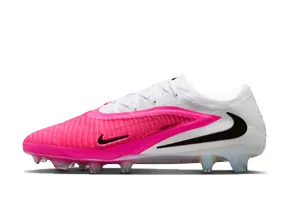 Phantom 6 |
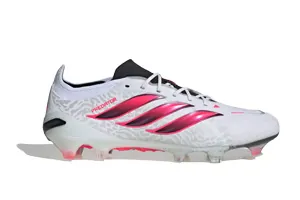 Predator 26 |
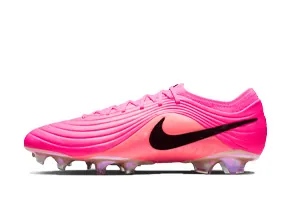 Tiempo Maestro |
|
|---|---|---|---|---|
| Job on the pitch | Soft, direct touch with rotational freedom | Grip and structured lockdown for sharp cuts | Striking grip and midfoot stability | Padded, uniform softness |
| Upper | Dynamic TouchTech microfibre | Tuned Gripknit | NanoStrike+ (firmer, more break-in) | TechLeather |
| Underfoot | Nylon plate, conical and rim studs | Cyclone 360 plate | Strikeframe and PowerSpine | Firm, structured |
| Grip | Subtle, restrained | Noticeably more friction | Integrated grip elements | Dampened, protective |
| Choose it for | Immediate comfort, natural touch, rotational freedom | Stronger ball grip, sharper changes of direction | Striking grip, midfoot stability | Greater padding, uniform softness |
Tekela v5 vs Nike Phantom 6 Elite
The Phantom 6 is the more technology-driven control boot. Its Tuned Gripknit upper produces noticeably more friction on the ball, while the Cyclone 360 plate gives a firmer platform when planting, pivoting and cutting sharply. The Tekela feels softer, less restrictive and more natural, with its subtle texturing assisting touch without making the ball feel attached to the upper. Its conical-led stud pattern also releases more smoothly when turning, though it lacks the Phantom’s lateral stability and aggressive grip. Choose the Tekela for immediate comfort, a more natural touch and greater freedom through rotations; choose the Phantom 6 for stronger ball grip, more structured lockdown and sharper changes of direction. Read the full Phantom 6 review.
Tekela v5 vs adidas Predator 26 Elite
Both are designed around control, but they approach it very differently. The Predator’s NanoStrike+ upper is initially firmer and needs more breaking in, though its integrated grip elements give greater assistance striking, crossing and playing driven passes. Its Strikeframe outsole and PowerSpine also create a more rigid, planted platform through the midfoot. The Tekela is considerably softer from the beginning, with a more flexible plate and a cleaner, less manipulated sensation on the ball. I’d side with the Tekela for close control, quick combinations and turning under pressure, but look at the Predator if I want greater striking grip, midfoot stability and a more substantial connection with the ground. See our Predator 26 review.
Tekela v5 vs Nike Tiempo Maestro Elite
The most interesting comparison is how each boot interprets synthetic leather. Nike’s TechLeather attempts to reproduce the plushness and mouldability of natural leather, delivering a consistently soft, slightly dampened sensation from heel to toe. It feels more luxurious and protective, with the material wrapping around the foot rather than producing an especially sharp touch. The Tekela’s Dynamic TouchTech microfibre is thinner, lighter and more direct. It still has a leather-like pliability, but its purpose is to communicate the ball clearly rather than cushion every contact. Select the Tekela for a streamlined synthetic-leather feel, sharper feedback and quicker multidirectional movement, or opt for the Tiempo Maestro for greater padding, uniform softness and the closest modern synthetic interpretation of a traditional leather boot. Read the full Tiempo Maestro review.
Where the other three take you
Choose for stronger ball grip and sharper changes of direction.
Read the Phantom 6 reviewChoose for greater striking grip and midfoot stability.
Read the Predator reviewChoose for greater padding and uniform softness.
Read the Tiempo Maestro review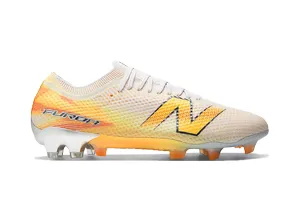
Choose for a sharper, more direct speed-boot sensation and firmer lockdown.
Read the Furon v9 reviewElite, Pro or Team: which Tekela v5 should you buy?
This review is based on the Elite. Unless you are particularly sensitive to upper softness or heel shaping, the Pro is the strongest value in the range and the tier most players should consider first.
The Tekela at its softest and most refined. Dynamic TouchTech microfibre combines debossed channels with printed grip elements, while the Hypoknit collar, anatomical heel and 3D-moulded insole create the most cohesive fit of the three tiers. The lightweight nylon plate delivers the Tekela’s intended balance of moderate snap, natural flexibility and multidirectional traction.
Retains most of what makes the Elite effective: a lightweight microfibre PU upper, debossed and printed grip details, and the same Elite-level nylon outsole and stud configuration. The knitted collar, heel package and moulded insole feel slightly less sophisticated, so the boot does not wrap the foot quite as seamlessly, but ball touch, flexibility and traction remain remarkably close.
Maintains the general Tekela shape, debossed upper channels and one-piece knitted collar, but replaces the premium construction with a more substantial synthetic upper. It remains reasonably soft for an entry-level model, though touch becomes more cushioned and the boot takes longer to feel natural. Its dual-injected TPU outsole retains the mixture of conical and angled rim studs, but the plate is heavier and lacks the cleaner flex and response of the nylon tooling.
The softest, most refined upper and the build this review is based on.
Check the Elite at New Balance ↗The strongest value in the range, nearly all of the Elite experience.
Check the Pro at New Balance ↗A respectable recreational option on a tighter budget.
Check the Team at New Balance ↗Where to buy
Tekela v5 Elite. A control boot that plays broken-in from the first session, with a sculpted heel that does the lockdown work the lace run cannot. Sizes and current colourways are on the New Balance site.
Check availability at New BalanceAffiliate link via Skimlinks. Opens New Balance UK in a new tab. Full disclosure is at the top of this review.
Tekela v5 questions answered
| Question | Short answer |
|---|---|
| What type of football boot is the Tekela v5? | New Balance’s control boot, though it does not rely on aggressive rubber elements. Its identity comes from a soft, direct upper, subtle surface texture and an outsole designed for turning and multidirectional movement. |
| Does the Tekela v5 fit true to size? | It fits true to size in length. Its standard shape is reasonably accommodating, though the toe box sits relatively low and may press against high-volume feet. Try the wide version before sizing up, since additional length can make the lockdown less precise. |
| Is the Tekela v5 suitable for wide or flat feet? | The pliable upper can adapt to mildly wide feet, while selected Elite, Pro and Team models are also available in a dedicated 2E width. For genuinely wide or flat feet, that version is preferable to increasing the length. |
| Does the Tekela v5 require breaking in? | Very little. Dynamic TouchTech is already soft and flexible out of the box, with the collar and heel normally needing only a short session to settle. It is one of the easier premium boots to take directly into training. |
| Can the Tekela FG be worn on artificial grass? | The FG configuration is intended for natural grass. Although its rounded studs appear relatively forgiving, the angled rim studs can still generate too much resistance on some artificial pitches. Use an AG, MG or HG version appropriate to your surface whenever available. |
| Is the Elite worth buying over the Pro? | The Elite provides the most refined upper, collar, heel and insole package. The Pro retains a microfibre upper, grip detailing and the same nylon outsole concept, making it the better-value choice for most players. |
| How does the Tekela differ from the Furon? | The Tekela prioritises softness, close control and multidirectional freedom. The Furon offers a thinner speed-boot sensation, firmer lockdown and more forceful straight-line traction. Choose according to the experience you prefer rather than your playing position alone. |
Final verdict
New Balance Tekela v5: FootballBoots Verdict
Buy it if
- You want a soft, direct touch with very little break-in
- Your game is receiving, turning and quick combinations
- You value secure heel lockdown
- You want a 2E option for wider feet
- You play mostly on natural grass
Avoid it if
- You want the Furon’s sharper speed-boot feel
- You have a high-volume foot
- You want a rigid, tightly braced midfoot
- You want Predator or Phantom-level grip
- You play mainly on artificial grass
Read the full final verdict
What is it trying to be? A soft, direct control boot for receiving under pressure, turning and quick combinations, calmer and more natural than New Balance’s own Furon.
Does it succeed? Yes. Dynamic TouchTech and the sculpted heel deliver on comfort and lockdown without pretending to be a rigid speed-boot fit.
Who benefits most? Central midfielders, number tens, wide creators and forwards who drop to link play, with narrow to mildly wide feet.
Who should avoid it? Players wanting the Furon’s sharper lockdown, high-volume feet, or anyone wanting Predator or Phantom-level grip.
Where does it sit in the silo’s history? The v5 moved away from the full-knit era and returned to a lightweight microfibre upper, arguably the clearest expression of the Tekela yet, comfortable and technical without depending on a laceless identity or an overly engineered upper.
How the Tekela has changed over time
The Tekela arrived as the successor to the Visaro, but its development has been anything but linear. New Balance has moved the silo from microfibre to knit, from laced to laceless and then back towards a low-cut laced construction. What has remained consistent is its attempt to give technical players a close touch and the freedom to move in multiple directions.

Moved away from the full-knit era and returned to a lightweight microfibre upper. Dynamic TouchTech combines natural pliability with debossed channels and understated grip printing, producing a softer but more direct sensation than the v4+. A Hypoknit collar and deeper anatomical heel support the low-cut laced construction.

A careful refinement. Its Hypoknit upper received revised surface texturing, the heel became more anatomically curved and a moulded FuelCell insert added underfoot comfort, though the claimed propulsion was modest in practice. The laced low-cut version increasingly became the reference model.

New Balance expanded the Tekela rather than forcing every player into a laceless boot, offering a low-cut laced model alongside the high-collared version. The full-foot stretch-knit upper became cleaner and less heavily textured, while a new outsole introduced central conical studs and angled rim studs.

The Tekela 3 was the first major reinvention, becoming New Balance’s first laceless football boot with a high-cut Hypoknit construction. The 3+ addressed some of the stiffness and restriction through a more pliable knitted construction and slightly lower collar.

Introduced ahead of the 2018 World Cup, the original Tekela replaced the Visaro as New Balance’s control silo, with an NB70 microfibre-synthetic upper and Kinetic Stitch embroidery. The 2.0 shortened the tongue, deepened the lacing and improved lockdown while retaining the identity.
See what New Balance has in stock across the Elite, Pro and Team.
Check stock at New Balance