

Everybody seems into the current styles and builds of synthetic football boots. And why not? They seem to be coping with ever-increasing speed and intensity of today’s football. However, leather football boots at one point were the norm, and Mizuno through its Morelia II is a great reminder why K-leather once ruled and why the material stays relevant to this date.
After testing them out in a couple of training and game day matches, it’s really that plushness and softness of the K-leather upper that brings out the best of the Morelia 2. The comfort and adaptive fit helps the Morelia cater to a variety of foot shapes, and while lagging slightly behind relative to modern football boots, the responsiveness and lockdown is still up there especially for a pair of leather boots.
What You’ll Find On This Page:
- My Mizuno Morelia 2 Made in Japan Review
- Key Facts About Mizuno Morelia 2
- Morelia 2 Options
- Mizuno Morelia 35th Anniversary Celebration
About the authors: This review was co-written by Dean Ariola, FootballBoots.co.uk’s Chief Writer, and Ian Ebbs, founder of FootballBoots.co.uk, host of the site’s YouTube channel and author of the Boot Secrets guide. Ian bought these boots himself to provide an independent review.

What’s New with the Morelia 2:
- For the changes from Morelia 1 to Morelia 2, proceed to the 35th anniversary discussion.
- Changes to the Morelia 2 since its inception in 1991 has been incremental, but significant! What we can say is that over the years there have been changes made to the heel liner, soleplate plastic and last/shaping.
FAQs about the Mizuno Morelia 2:
How do I maintain the leather?
Since this is a natural material, it requires more love than a synthetic boot:
Condition: Use a leather cream (like Mizuno’s own “P. Conditioner”) once a month to keep the K-leather supple and waterproof.
Clean: Wipe off mud with a damp cloth (never submerge them in water)
Dry: Let them air dry naturally. Never put them on a radiator, as this will bridge the leather and make it crack.
How much does a Mizuno Morelia 2 MIJ weigh?
Is the Mizuno Morelia 2 worth it?
Yes — if you are ready to break the bank to get the most premium of leather boots out there.
The Mizuno Morelia 2 is an open secret in the football boot community as the gold standard of leather boots (even football boots in general to some hardcore Morelia fans). Whereas other brands would change for the sake of change, Mizuno’s incremental changes to the Morelia 2 had always been targeted, resulting to the boot getting better and better over the years.
My Mizuno Morelia 2 Made in Japan Review

- Release Year: 1991
- Generation: 2nd
- Purpose: Heritage Boot
- Competitor/s: adidas Copa
- Notable Players: Rivaldo, Shinji Okazaki
Five Things You’ll Want to Know About The Morelia 2:
- Morelia has been around since 1985
- Costs more ore less £300
- K-leather from toe to heel and classic all-conical stud layout
- Half-a-size down to offset some of the leather stretching; good for wide feet in a true-to-size
- The traditional offering in contrast to the synthetic Alpha and progressive Morelia Neo+
Testing Conditions
- Surfaces: Firm ground and artificial grass
- Weather: Dry and damp sessions
- Sessions: 2 Competitive Matches, 2 Training Sessions
- Foot Type: Medium Width (EU 43 1/3)
- Playing Position: Centre Back
- Playing Style: Ball Playing Centre Back; Build-up from the Back
- Break-in Time: Approximately 30 minutes
K-Leather Upper + Fit and Feel
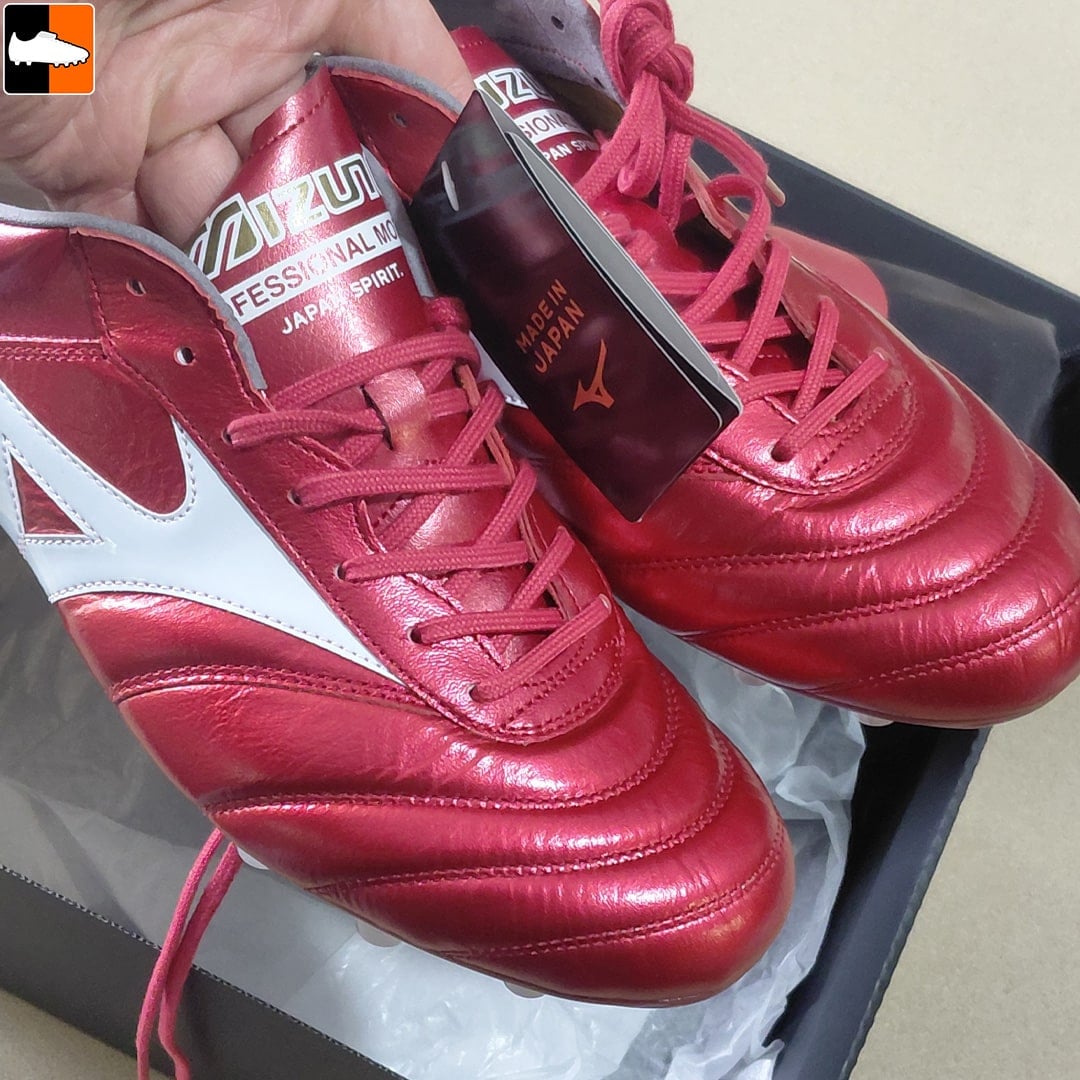
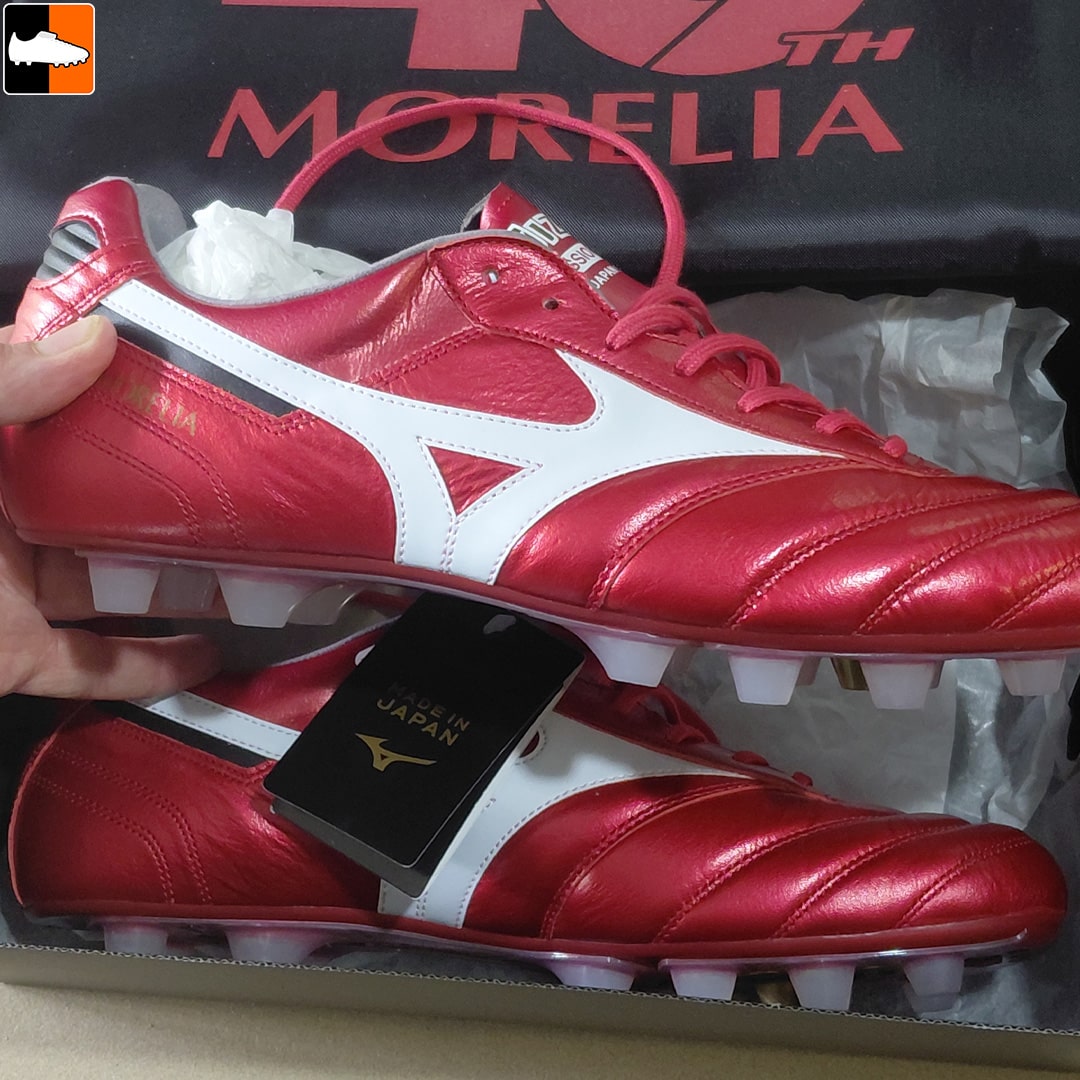
If it’s not yet clear enough at this point, then be advised that the K-leather of the Morelie 2 is simply the standard itself in terms of how a premium leather upper should feel. It’s very comfortable straight out-of-the-box because of that buttery smooth wrap around your feet. Thanks to a combination of the synthetic Runbird logo, stitching pattern and leather treatment, the responsiveness is certainly above-average for an upper that is so plush and pliable. And once you get the laces tied tight and adjusted the boot (thanks to the regular tongue construction), you’ll be surprised how much locked-in sensation you’ll get. This is greatly assisted because of the anatomical heel shape as well as the premium suede liner and padding on that part of the boot. You’ll get better options out there if objective performance is just what you’re after, but what you’ll get from the Morelia 2 is not bad at all.
Shape-wise, it’s a neutral one that will adapt to both narrow and wide feet. Narrow feet players, and others who would like to make their boot fit one-to-one, might prefer going half-a-size down. Wide feet, or those who would like to enjoy a bit of a wiggle room might stick true-to-size. As a leather boot, you should expect a bit of overstretching, and that should also factor in when considering your preference to sizing.
Resin Soleplate


Thanks to their adherence to ‘Kaizen’ or ‘small improvements,’ Mizuno is able to make the Mizuno light over the course of time. This is best reflected to the resin used for the soleplate. You can see that the plastic has this translucent finish, which probably allows it to become light without sacrificing durability. What I also like about the soleplate is that the stud configuration is pretty much friendly to both natural and synthetic pitches. I don’t have any stud pressure in any of the playing surface I have tested it with, and the bite on the ground really gives me a stable underfoot feel (as if I’m playing on a flat surface).
The only thing that might be pointed out is that the snap is a bit lacking, especially when compared to the energy return of some of the leading speed boots. That said, the neutral flexibility jives well with the comfortable pliability of the upper. The Morelie 2 gives credence to the thought that ‘sometimes, all you need is a pair that fits well and feels comfortable.’
✔️ Pros
- Finest full K-leather boot
- Feels like butter on bread in terms of fit because of the excellent synergy between leather quality, the boot shape and the laces with the standard tongue construction; ridiculously comfortable
- Deceptively lightweight; trending towards the weight of modern synthetic boots rather than classic leather boots like the Copa Mundial
- All-conical stud layout somehow gives it some AG applicability
❌ Cons
- A bit old-school in looks, and colourways usually lack some graphics
- Not necessarily performance-oriented
- Elite takedown option offers great value for money, rendering the Made in Japan not a necessity despite the additional quality
Key Facts About Mizuno Morelia 2
Boot type: Heritage
Generation: 2nd
Upper: K-leather that is soft almost straight out of the box
Grip: Natural leather surface with some stitching
Stability: Lightweight resin
Fit: Average to Wide
Best surface: Firm ground and dry conditions
Morelia 2 Options
True to their reputation, Mizuno puts up a strong lineup of Morelia 2s out there, from the most premium Made in Japan model down to the takedown Pro entry.
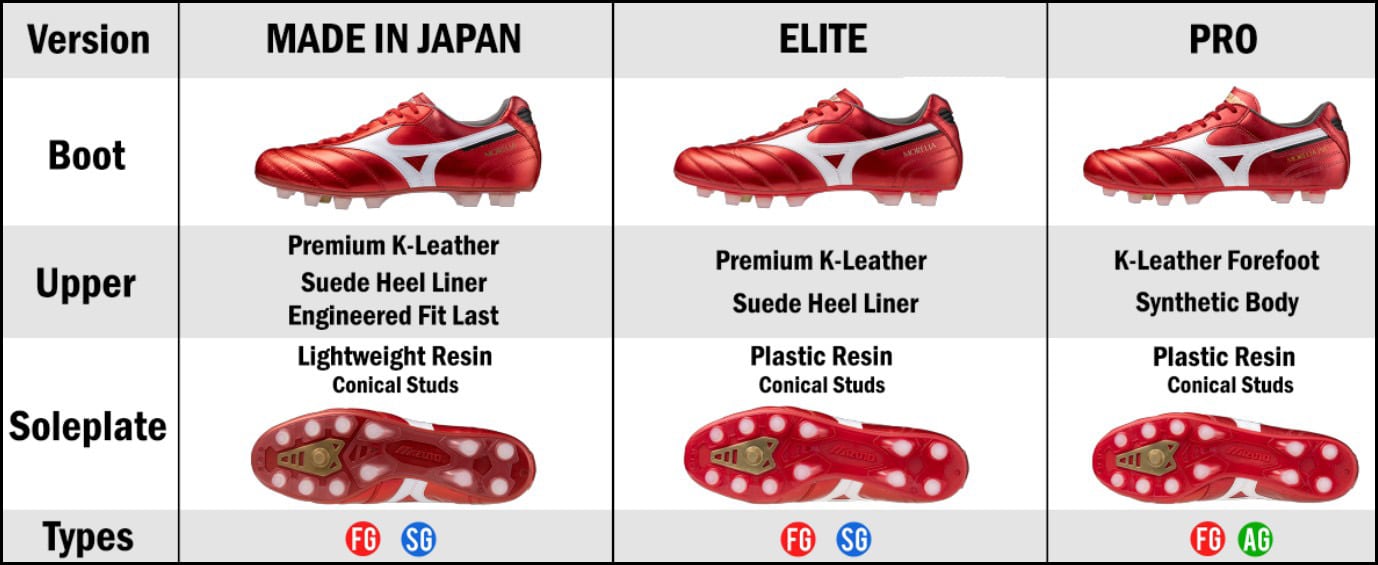
The Made in Japan has all the materials geared towards making the boot as light as possible. The Elite is not far enough, having less (but nonetheless still) premium materials, which somehow adds a bit more weight. The thing is the Elite can go toe-to-toe with the Nike Elites and adidas pluses or .1s, even though it is meant to be a takedown option. If the first two are your BEST and VERY GOOD options, the Pro we can say is your GOOD one.
At the Elite level, you’ll just notice that it’s not as soft, shaped and light as the MIJ variation. The main reason for this is probably the fact that the former is not lasted for 24-hours like the top-tier model. The Pro is where you will notice a significant change, as the K-leather is limited to the forefoot and the rest of the upper is made of synthetic. What you miss though in the comfort levels from the MIJ and Elite because of the addition of synthetics, you gain in structure and responsiveness. What’s more, it doesn’t take that long to even breakdown that synthetic material. And once that’s done, you can even make the argument that the Pro might even compete directly with the Elite models of other brands that also has that same combination of a K-leather forefoot and a synthetic midfoot.
Mizuno Morelia 35th Anniversary Celebration
The first Morelia was launched in 1985 and morphed into the Morelia II in 1991. Since then the Morelia II had seen several renewals, with each contributing a thing or two to Mizuno’s Morelia principles of “lightweight/flexible/barefoot feeling.” It was in 2020 during the 35th Anniversary of the silo that Mizuno produced the Morelia 2 which we are now familiar with. Note that ‘II’ has been changed to ‘2’ as part of the brand’s naming standardisation.


Safe to say that between 1985 and today, the Morelia maintained its looks and premiumness of the K-leather while introducing incremental changes to the different aspects of the boot like the tongue, lining, soleplate and laces. However in 2020, aside from renaming the ‘II’ to ‘2,’ a significant change was applied to the last. The Morelia 2 is based on the ‘engineered fit last,’ claimed by Mizuno as more representative of today’s foot shape than the one they used before.
It has been 35 years since the birth of the first Morelia.
While maintaining the concept of “lightweight/flexible/barefoot feeling”, the last, which can be said to be the life of shoes, has been renewed for the first time in 30 years.
For modern footballers, all parts have been reviewed from scratch, anda pair of shoes with a better fit has been completed.
-Mizuno, 2020

Given that the Mizuno lasting process ‘lasts’ 24 hours instead of the industry-standard 20 minutes, the new shape consequently changes the fit of the boot. This is best seen on the shape of the heel, which is now narrower than it has been previously.

The fold-over tongue is now smaller with the velcro at the back being wider for better security-in-place. However, the Morelia 2 with fold-over tongue is available mostly in Japan, and other places like Mizuno Europe more often than not sells the short tongue versions (which should explain the tongue difference between the abovementioned images versus the Morelia 2 options presented on this page.


